
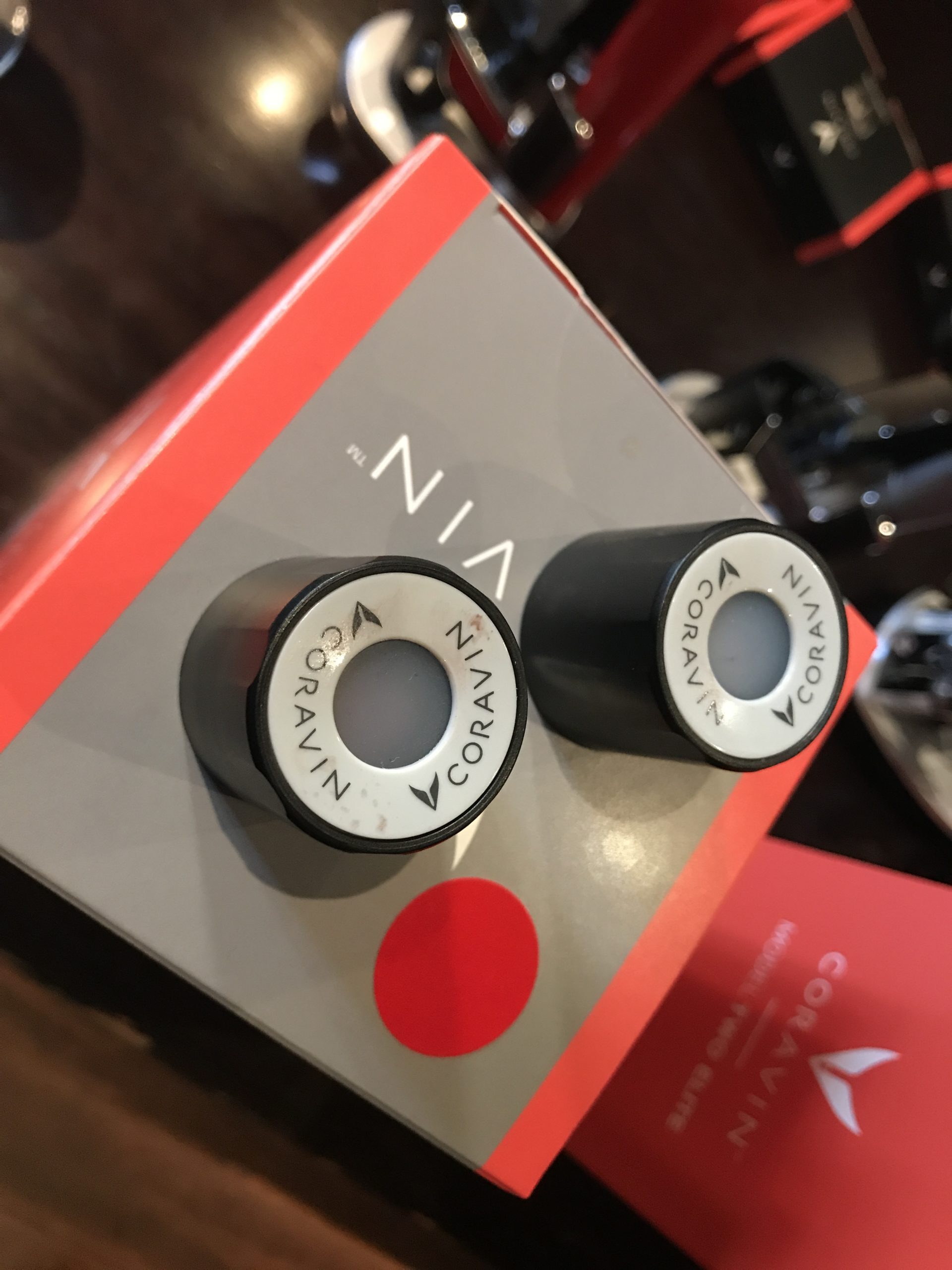
Coravin Screw Caps
I was sceptical. And full of questions.
This week was the Sydney launch of the new Coravin Screw Caps; a brand accessory to the Coravin ‘wine access’ system to allow for use on screwcaps.
What made the launch a)intriguing b)potentially revelatory is that Coravin is designed for corks, not screwcaps. In fact, some pundits thought that screwcap adoption might be under threat; such is the love for Coravin’s powers.
Firstly, if you’ve not played with a Coravin before, then you’re not alone – it was launched in July 2013 and ‘official’ distribution in Australia has only been locked in for within the last 18 months.
What it lacks in history, however, this device has made up in hype, with the likes of Robert Parker Jr. describing it as ‘a killer device’ that is going to ‘revolutionise drinking wine’.
Lofty words. But this is, in my opinion, a pretty handy gadget.

Coravin as a concept dates back to 1999, invented by former nuclear physicist Greg Lambrecht. Lambrecht, like many, was stuck with the age-old problem of what to with half-opened bottles of wine uncorked when your partner is pregnant. A medical instrument inventor by trade, he then came up with solution – a prototype device that ‘accessed’ bottles using a hollow spinal needle inserted through the cork into the bottle to draw out wine. Then, an inert gas (Lambrecht has experimented with both nitrogen and argon before settling on argon) is pumped into the bottle as wine is removed. The needle is then withdrawn, with the cork naturally flexing back into shape while the gas protects the wine.
While this sounds simple (or not), it took until 2013 for Lambrecht to finally launch the product, and even then it was a bumpy ride, with the device recalled after incidences of exploding bottles.
Still, it has gained serious traction since then, notably amongst restaurants and wine bars. In such settings, the notion that you can pour a glass for a customer without opening a bottle is a game changer. I spoke to Stu Knox, of Sydney wine institution Fix St James, at the launch and he couldn’t be more of a fan. For Knox, it means being able to pour single glasses of Barolo for time-pressed business people who want just a glass, all without the worry that comes from potential wastage of a $400/bottle.
Knox has been one of those to help trial the new Coravin Screw Caps too, and he’s now even more enthused, as the Screw Caps open up the Coravin for usage on uniformly screwcap-sealed Australian/New Zealand wines.

The principal behind the Coravin Screw Caps themselves is not to adapt the device but to adapt the seal. This entails a plastic screwcap with a hollow, silicone rubber centre (see pic above) that is put over the top of the bottle to replace the original cap. A new Coravin cap, in other words. So you just unscrew the bottle, replace it with a Coravin Screw Cap and then you can access the bottle much like it is a cork, with the squishy, highly flexible rubber resealing in a similar fashion.
To demonstrate the effectiveness of these Coravin Screw Caps – and indeed the Coravin itself – Lambrecht had us taste two different screwcap-sealed wines in five glasses. We were given the identity of the wines (a Mesh Riesling and a Tarrawarra Pinot, the Pinot looking best) and told that some of the glasses contained wine from bottles opened on the day, and others from bottles that had been ‘accessed’ six weeks ago and left with an (unspecified) ullage. The game was to pick which was which.
Unsurprisingly, the whole room failed. I managed to identify just one of the four glasses of wine from the previously ‘accessed’ bottles, and it was hard going. There just wasn’t enough of a difference, even on reflection, to say which was which.
A win to Coravin.
Indeed, this is a seriously impressive device. Yes, it’s not cheap ($329 is the lowest price I’ve seen the basic Model 1, with the sexier Model 2 Elite circa $549+), but that ability to have just one glass from a famed bottle is seriously attractive. And now, with the Coravin Screw Caps available (and a rumoured sparkling option in the works) it’s not hard to see the appeal.

Ultimately, I’m not the one who will get the most value out of a Coravin though. Instead, it is wine bars and restaurants like Fix St James that will be able to use the Coravin to its potential. For a wine bar, it suddenly turns the entire wine list into ‘by the glass’, whether the bottle is corked or screwcap sealed. A real life-changer.
The drawbacks of Coravin? Well, besides the cost of the system itself, the gas canisters are pricey – it works out to circa $1.33 for a 150ml glass. The argon comes from Austria, and Lambrecht mentions that it is anything but cheap. Further, well-ullaged bottles can apparently degrade/look ‘flat’ over time, much like they do in other gas-based wine preservation systems (like Enomatic). There have also been issues on aeroplanes with low ullaged bottles leaking, and Lambrecht recommends that you keep all wines on their side and well-ullaged bottles upside down.
Locally, one other issue that the Australian distributor Negociants have encountered is the odd Coravin that isn’t clean. Apparently, this means problems with acetobacter and brett from within the needle. Given that it the whole machine is washable – and the needle purges when you push gas through it – this seems more like lack of care than anything else.
Otherwise, the ultimate question is whether you need one. Surely the joy of a bottle is sharing it with others? Or opening a bottle and drinking it over several nights? That notion obviously ignores the benefits of a Coravin, but it’s still a philosophical consideration.
As for me, I’ve got a trial Coravin on its way and will report back on whether I’m convinced I need one in my life. At this stage I’m keen, but the proof will be whether I then want to go out and buy one when the trial unit goes back. Watch this space….

Coravin Screw Caps are now available in packs of six for circa $50AUD. The caps come in ‘standard’ and ‘large’ to cope with the two main screwcap sizes.




Leave a Reply