
This is an edited version of a feature on Australia’s first ever Nerello Mascalese vines that appeared in a print publication back in 2020. As I wrote about here, I’m reposting a pack of print features given that I’m still unpaid for them, and the publication in question is looking less viable by the day (this week, they deleted their social media accounts!).
One thing dominates the skyline as you fly into Catania on Sicily’s western shores.
Etna.
While Mount Etna is more famous for the occasional fiery eruption, this Italian monolith is not just another active volcano. Instead, Etna is the vanguard of Italian wine. The mountain’s lower slopes are home to some of Italy’s most enchanting wines – all crafted by the country’s most fashionable, boundary-shifting vignerons.
Beyond the hype, the sheer volume of impossible-to-replicate elements makes the finest Etna vino so unique. Think ancient – and exclusively dry-grown – vineyards planted to obscure indigenous varieties. Of vineyards, backdropped by the distant, steaming crater, perched high up on slopes over 1000m in altitude, and planted in fertile soils from all-too-recent lava flows.
You can almost see the drama in the vineyards.
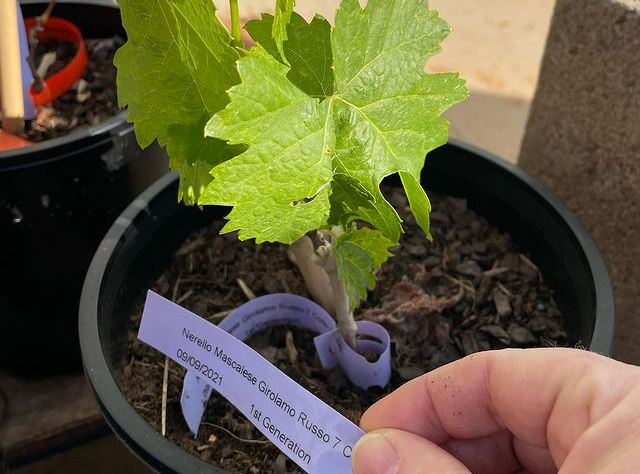
And now, one pioneering wine family is seeking to bring some of that Etna DNA to our shores, with Australia’s first-ever DNA-certified cuttings of Etna’s charismatic red hero variety, Nerello Mascalese, now (finally) sitting in a secure quarantine facility in Melbourne.
However, the process to get to this point spans decades and traces the history of many Italian varieties in Australia.
Enter the Chalmers
The winners of the 2014 Viticulturist of the Year, the Chalmers family is singularly responsible for bringing Italian varieties like Sagrantino, Aglianico and Vermentino to Australia.
But it wasn’t always that way.
In the 1990s, Bruce and Jenni Chalmers were large-scale grapegrowers with one of Australia’s most extensive vine nurseries, if primarily focused on ‘conventional’ varieties. However, the involvement of the late Dr Rod Bonfiglioli steered the family in an Italian direction.
Bonfiglioli was an Adelaide University-based researcher looking for a tree change. Once he landed in Euston, he convinced Bruce and Jenni to look towards Italy for varieties better suited to the Murray Valley climate. Thanks to Bonfiglioli’s Italian connections, the Chalmers lined up access to Vivai Cooperativi Rauscedo (VCR) – the largest grape nursery in the world – and Matura as potential sources of new grapevine material.
But the plan hit a speed bump. Due to Australia’s strict quarantine laws, the Italian nurseries couldn’t send vines directly. So instead, the Chalmers family shifted again and became their Australian agents, an agreement that still stands today.
What came next remains a pivotal moment for Italian red grapes in Australian history. In 1998, Bruce and Jenni worked with VCR, Matura and a host of producers in Italy to select a long list of over 70 different clones across multiple varieties to bring into the country.
While some of the most eclectic vineyard selections didn’t make it through quarantine (notably several Tuscan varieties obtained by legendary winemaker Alberto Antonini), those that did include key varieties that we now take for granted, think Australia’s first Nero d’Avola and Vermentino – grapes which, as second-generation Chalmers visionary Kim Chalmers explains, ‘are now shaping viticulture in Australia’.
Intriguingly, when Bruce Chalmers approached the big wine companies of the early 2000s – like Orlando & Southcorp – to pitch these new Italian varieties, he thought it would be an instant winner. The future of wine, with grapes much better suited to Australian conditions. But the big companies just weren’t interested. So instead, the theory was ‘if it ain’t broke, don’t fix it’ with Shiraz, Chardonnay and Cabernet Sauvignon much more straightforward propositions.
Rather than be disheartened, the Chalmers decided in 2004 to change tack again and make wines for themselves.
Primarily intended as an advertising tool to showcase the potential of grapes like Sagrantino and Negroamaro, the success of those early 2000s wines (made by Sandro Mosele at Kooyong) served as billboards for what these varieties can deliver.
The second wave
Inspired by this early success, the Chalmers then made a second lot of selections in 2011, as Kim Chalmers explains:
‘The first time around, we picked out what was popular at the time. It was 80% red varieties and lots of Sangiovese and Nebbiolo clones which the family knew would be popular, with a few random things like Schioppettino’.
‘Then, in 2011, we were able to see what was working and what was making sense from a viticultural standpoint’.
On this second list were varieties like Pecorino, Ribolla Gialla and Falanghina – grapes chosen with a secondary purpose – to change the notion of what our inland wine regions can achieve.
‘The perception is that the Riverland and Mildura can’t get any better. It makes commodity wine and a wine for the people but never going to be fine’ said Kim.
‘But we don’t believe in that. That’s rubbish. Using clever viticulture is the answer. Find the variety that will do the best in a place. The marketers on the other end just have to sell this stuff’.
Kim undertook a research trip in 2012 to Italy focused on the hot climate grapes championed in southern Italy – including Aglianico, Nero d’Avola and indeed Nerello Mascalese – that reinforced just how promising such varieties are for our warmer wine regions. These grapes thrive in hot summers, are adapted to low rainfall and conditioned to heatwaves, all while making world-class wines – a combination that lines up perfectly for the Murray-Darling and is especially important given the prospects of climate change.
Nerello Mascalese
The hero of Etna was on the 2011′ want to have list’ too. Here’s a grape that promises the vivacity of Pinot Noir and makes famously beautiful wines in a dry and hot climate welcomingly similar to northern Victoria. It couldn’t be any more promising.
But finding DNA-certified, healthy Nerello Mascalese proved to be a tough ask. The Chalmers family tried everything – contacting Palermo University (which didn’t work out), tasking a local Mildura viti consultant (no luck) and reaching out to all and sundry.
‘Given that original experience we had of some of those vineyard selections destroyed due to viruses and other issues, we wanted to be sure that even before the cuttings left Italy that it was the right thing’ Kim said.
‘Especially after the Albarino scandal and now Gros Manseng, we always want to make sure what we bring in is officially classified and virus-free’.
Enter Italian viticulturist Stefano Dini.
One of Dini’s colleagues helped with the original importation of Italian clones from Matura in 1998, and Dini himself was seconded to Australia. He lived with the Chalmers for several years and became a de facto family member, with Kim calling him ‘our Italian brother’. The bond is so strong that Jenni Chalmers walked Dini – whose parents have passed – down the aisle.
Dini offered to help as he knew first-hand the problems with Nerello Mascalese.
‘Unlike the other Italian varieties, little research has been done on Nerello Mascalese for finding clones which would give the optimum results in any region’ he said.
‘The most important nurseries in the world, universities and research institutes have always faced many difficulties in finding healthy vegetative material’.
‘This was the reason why many Sicilian companies have started doing their own selection – infamous massal selections, calling them by the name of the contrada or linking them to a specific producer’.
Such selections are deeply problematic from a DNA perspective. For example, one study cited in Jancis Robinson’s authoritative Wine Grapes book explains that from a sample of 111 vines from commercial vineyards, there was a mix of true Nerello Mascalese and five other ‘distinct but undetermined varieties’.
‘Fortunately, there are still some very old vineyards on Mount Etna, so finding (genuine) Nerello Mascalese plants there which do not show any viruses is possible’ Dini explains.
The pursuit for genuine Nerello Mascalese led to Giuseppe Russo of Girolamo Russo. Russo is one of Etna’s most revered producers, with his small patch of old Nerello Mascale vines on Etna’s northern slopes delivering simply stunning Etna Rosso.
Helpfully, Dini consults to Russo and pitched the notion of spreading the Mascalese love worldwide. Again, Russo was keen, and finally, a selection of healthy, DNA-certified cuttings was made and shipped to Australia in March this year.
As Kim explains, the welcoming attitude of producers like Russo isn’t necessarily the norm.
‘There are two schools of thought about how Italians view others working with Italian grape varieties’ she notes.
‘There’s the Prosecco approach, which is to ban everyone else using them because “they’re ours”. Then there is the collaborative approach from people like Giuseppe, who says, “this is great. I can’t wait to see what Nerello Mascalese can taste like in Australia”.
Indeed Chalmers has experienced both sides here. The family were once threatened by the Montefalco Consorzio, with a legal letter sent to a bottle shop in London stocking Chalmers Sagrantino claiming ‘false advertising’, the implication that the grape that could only come from Italy. Thankfully the Wine Australia diplomatic route sorted it out, with surprising results.
‘A few years later, I was invited by the Consorzio via Marco Caprai to come and present our wines at the Enologica festival. I spoke on a panel, and they inducted us into the Confraternita del Sagrantino. We were the first non-Italian producers to be inducted’ she said.
By contrast, Dini sees only an upside for spreading the Nerello Mascalese footprint.
‘We are convinced that the more we talk about it in the world, the more people will become curious and the more they will go in search of the origins of this variety which nobody can replicate’ he said.
Kim agrees.
‘If you go thinking that we’re going to be able to make Etna Rosso in Australia, I don’t think we can’ she said.
‘But I think we can make beautiful light wines that are going to be really elegant and expressive. In our vineyard at Heathcote, I can see it looking like Nebbiolo’.
Nerello Mascalese is more than just an ‘it’ variety. In the Etna DOC, the wines have an ethereal quality too. As Jancis Robinson notes, the reds can be ‘dense and haunting’, with Nerello Mascalese itself showing ‘very obvious nobility and lovely gentle tannins’.
There is no shortage of enthusiasm for the grapes amongst local vignerons. Late ripening, with high vigour and drought tolerance, it is perfect for so many Australian wine regions.
‘If I had a dollar for every phone call I’ve had asking if we had Nerello Mascalese, I’d have retired by now’ Kim explains.
‘We’ve got a waitlist that goes years and years back’.
The wait is now over. While the baby Nerello Mascale vines are in quarantine, Kim has found a way to at least get photos after explaining how invested they are in the project and the long lead times.
Indeed, it’s taken nearly ten years to get to this point. And Kim might not want to retire just yet, with the first plant not out of quarantine until early 2022. Then, it will take another season for more cuttings to be established before the first crop circa 2025. Even then, it could be circa 2030 before enough vines are planted commercially to make an impact.
‘I look now at Nero d’Avola, which first arrived in 2000. It’s taken twenty years to go from that first plant to then a variety that is starting to take off’ Kim said.
The process is a long-term labour of love, and an expensive one, with the cost approaching $5,000 a plant to get it here and through quarantine.
Finally, the lingering question is why the Chalmers family are motivated to keep bringing varieties like Nerello Mascalese into Australia.
‘We look at the success of Nero now like proud grandparents and realise it is all worth it’ Kim explains.
More broadly, Chalmers believes varietal diversity is the future for Australian wine.
‘I think it’s awesome to have all these wines you can find and drink now’ Kim notes.
‘As a consumer, it’s much more interesting to drink different things all the time. But as producers, different varieties can be a way for you to find your groove’.
‘More options to get it right is a better thing for the wine industry full stop’.
(Featured image is a baby Nerello Mascalese vine, now out of quarantine in Australia. Source – Chalmers Instagram).



Leave a Reply