

Beef and Cabernet: Made for loving
Sauternes and Roquefort. Caviar and Champagne. Sparkling Shiraz and turkey. Beef and Cabernet.
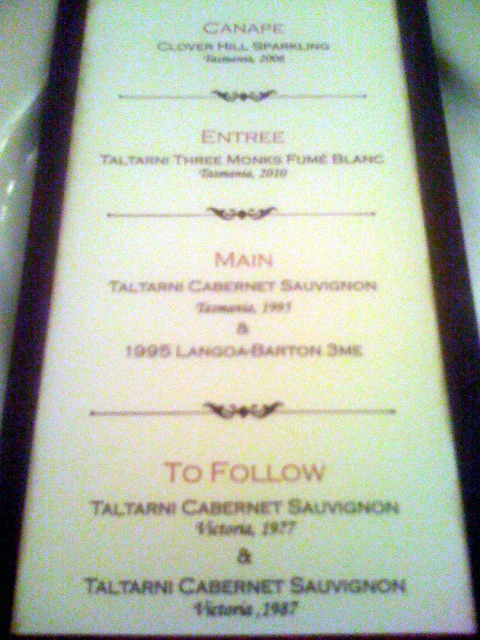 |
| The menu: Never knew they made Taltarni Cab in Tassie.. |
All of these things are ideal food and wine matches. Classical matches if you will, honed over many years of hard drinking and eating. In many ways they are pretty boring matches actually, particularly as people tend to follow such combos slavishly.
Yet last night I had the good fortune to give the last duo – beef and Cabernet – a thorough working over. That’s not to say I don’t regularly give the match a touch up, but last night’s outing placed a particular emphasis on this classic pairing (with great results).
For last night, at Sydney meat and crustacean outpost Kingsleys Steak and Crabhouse, I was a guest at the relaunch – if you will – of the Bordeaux and Beef Steak club, an 18th century London society of renowned booze hounds and carnivores. What set this little club apart was the combination of exclusivity – membership was by invitation only, and the patrons were generally considered to be men of wit and talent – as well as the singular focus on Bordeaux and beef.
Such was the exclusive nature of this secret meat and wine society that even the future king of England was only deemed worthy enough of a spot on the waiting list. Suitably, the plan for this new iteration is to maintain the invitation only plan, limiting numbers to just 24 people in total, with only every second diner gaining an invite to the next event with each of them thus given just a single plus one (so it paid to be friendly with the person next to you).
Personally I like the concept, like the enforced exclusivity of the event and – if the food and wines are always of this standard – would like to be a card carrying member. Suffice to say that it was an awesome night, made particularly so by the shit-hot aged wines and lovingly prepared, delightfully old school food.
The wines:
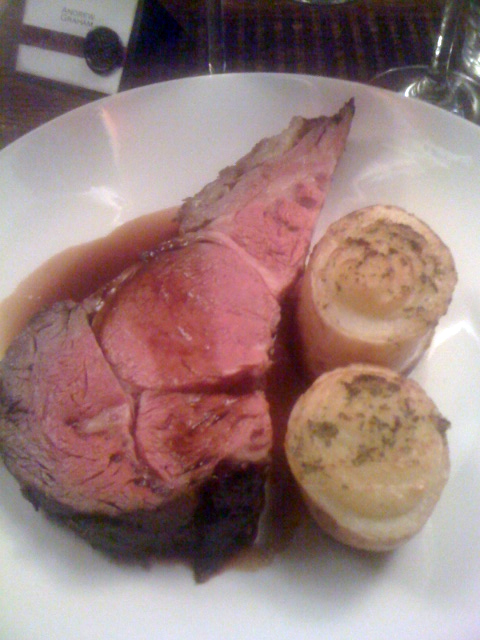 |
| Meat, glorious meat! |
Clover Hill Sparkling Brut 2006 (Tasmania)
Nice sparkling, if not quite climbing the heights of the best vintages. Really quite a caramelised yeast note on the note, real brandied richness there that is just a fraction heavy, if certainly convincingly rich enough. Palate is all in the green apple spectrum with briny acidity and some sweetness on the finish. It just needs a fraction more delicacy for bigger points, though it’s certainly still perfectly palatable. The rich soup was a reasonably good match too. 17/90
Matched with: Onion & Porter soup w/ a rock oyster
Taltarni Three Monks Fumé Blanc 2010 (Tasmania)
I’ve reviewed this here and there wasn’t all that much change to be had. If anything it looked even tighter and more structured in this lineup. Again, considering it’s relative pricepoint this is is smart booze. The artichoke and richness in the food was a bit of a clash with the wine however – artichoke seems to be a tricky one?
Matched with: Marron & artichoke salad w/ scampi mayonnaise
Taltarni Cabernet Sauvignon 1995 (Pyrenees, Vic)
Chateau Langoa-Barton 1995 (Bordeaux, France)
Boom! Step up to the big boys table! No messing around now. The differences between these two wines was quite apparent here, as the Langoa looked like a rather more stylish and structured wine than the Taltarni. I thought the Taltarni looked a little stewed and forward in the context (even though it’s probably only 13% alc.) with some evolved, bacon-bits bottle age characters over a rather generous, if still minty and regional palate. The rich heartiness here certainly matched the Bordeaux and it has much more stuffing, but it’s just not as well built as the Frenchie. 17.5/91
In contrast, the Langoa had a rather intriguing mushroom (Swiss Brown I reckon;)) nose over a typically juicy, warm year Bordeaux palate. The shape of this wine was really quite different, as it’s middle was fuller, whilst the tannins and line through the back were much more defined. It’s hardly a super complex wine – perhaps a little too full for that – but it does have Bordeaux character and proper ‘black’ graphite tannins and should get even better with more time. 17.8/92+
I can’t forget the food though. Chef Lars Svensson proudly paraded the lovely pink beef around before serving and it was one good looking, seriously delicious piece of dead cow. And the bone marrow desiree cakes? Awesomeness.
Matched with: Pasture fed Angus rib roast (carved at the table) served with; Desiree bone marrow potato; winter radicchio salad; green beans, bacon, chestnuts
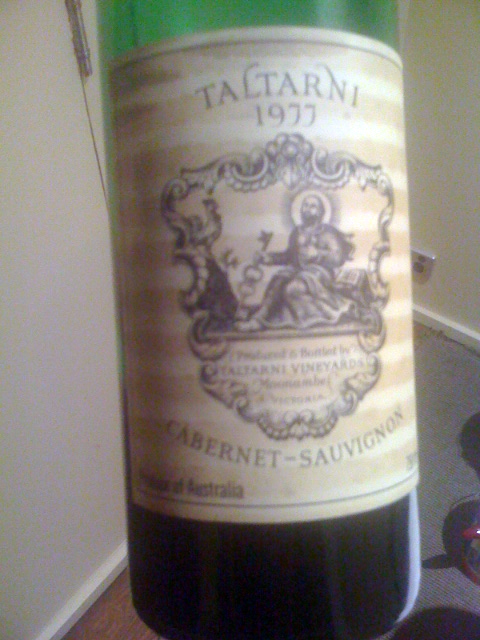 |
| Taltarni Cabernet Going strong! |
Taltarni Cabernet Sauvignon 1987 (Pyrenees, Vic)
Taltarni Cabernet Sauvignon 1977 (Pyrenees, Vic)
It was almost as if we’d entered another realm with this duo, with a step up that was really quite a surprise actually. The 77 in particular was almost revelatory, showing everything you’d want in an old Cabernet from any country. What was most intriguing was just how much more interesting either wine was than the much more famous Langoa. That’s likely a product of bottle age serving to fully resolve these older beauties, but I don’t want to discount the fact that these are likely just better wines. Suffice to say I was excited. More than that I was draining glasses, even though it was a school night and I wasn’t actually in drinking mode. Great wine will do that to you.
Of the two, the 87 is a riper styled wine, with a bit of that cooked fig warmth on the nose, the palate too suggests a warm year, with an opulence and big hit of richness. Yet after all this weight, the tail end is cool, taut and minty, the tannins regimented and dry. What really kicks this up a gear though is that as it sits in the glass it gets cooler, the hint of overt ripeness dissipates and the whole package looks blacker and more sophisticated by the minute. Lots of meaty satisfaction with this one. 18.1/93
Intriguingly, the 77 is an entirely different beast all together. It’s fully resolved and curranty with a mince pie sweetness on the nose that is really rather sexy. The palate is almost Burgundian such is it’s velvety black fruit texture and then topped off with fine, powdery tannins. Surprising, heart warming, genuine, brilliant tannins.
A magnificent wine this one, with a style that teeters between softness and structure all in one. Loved it, and particularly enjoyed it with the Eccles cake, which was like a little pastry fun box that appeared both savoury and sweet (much like a mince pie really). 18.6/95
It would be rude of me not to mention the cheese too, which I scoffed (even though I think it might have been too blue and rich for these oldies).
Matched with: Dows 04 LBV Port drenched Stilton cheese and Eccles cake
Special thanks then to Kingsleys for inviting me (though the food and vino was so good that it would have been worth the $95. No bull) and keep an eye out for a 77….


Leave a Reply