
That’s what I have been up to lately, and before the warm vinous glow wears off, I’m going to briefly document some of my observations from my 3 week long, 3 state ‘Tour of Wine’.
Onwards!
The surprises:
 |
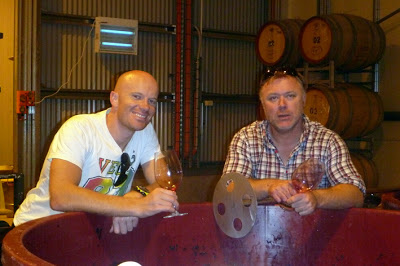
| Your author (on left) tasting the ferments with Dave Brookes at the Teusner winery. They make good beer too.. |
Look out for Kym’s 09 Mataros in particular, which tasted absolutely superb straight out of the barrel.
Beer: It takes a case of beer to make a case of wine, or so the saying goes, and it warms the heart of this enthusiastic beer hound to see so many new brews popping it, and popping up in the middle of wine regions. From the tasty new Seppeltsfield ‘Barossa Bock’, to the sessionable McLaren Vale ‘Vale Ale’ and onto the delicious Porter from Beechworth’s Bridge Road, it’s exciting to see some regional beer diversity out there. I even tasted an excellent Shiraz Stout, which seems like a marriage of two very good things indeed.
The Vintages (caution: vague and inaccurate generalisations below)
2007: Hard. For all the great wine this vintage gave us from the Hunter & Margaret River, everywhere else it seems to have been, simply put, a shocker. The 2007 vintage reds that are now populating cellar doors throughout South Australia show this particularly so, with wines that are often characterised by unripe tannins and overripe fruit, echoing the comment that the grapes got far too ‘sugar ripe’ without getting physiologically ripe.
Thus lots of hard and ungenerous 07 McLaren Vale and Barossan reds out there, coupled with overripe and full flavoured whites. Cabernet in particular was hit hard. The best wines are those that went with restraint and picked a little early.
In comparison, 2007 in Victoria saw problems of different shades. For Beechworth, the Strathbogie Ranges and the King Valley it was a killer spring frost that absolutely decimated the yields (to the point where some makers, such as Keppell Smith at Savaterre, declassified everything to a second label).
To follow it up, Summer bushfires then cast the dreaded pall of smoke taint all over the land, hitting the Yarra Valley and King Valley (again) particularly hard. Arnie Pizzini at Chrismont (for example) sold not a single wine from 2007, selling it all off as bulk juice. Similar story at Brown Brothers, who lost almost 2000 tonnes of grapes after saving it from the early frosts with some judicious helicoptering, only to see it end up with serious smoke taint.
So, for much of Northern Victoria, 2007 was largely a non event vintage wise, with most makers just bringing forward their 2008 wines to compensate (so little actual wine to comment on).
The same frosts that hit NE Vic also slashed Canberra’s yields too, again leading to a distinct lack of 2007 vintage wine at most cellar doors (though apparently some of the 07’s are quite good).
2008: Much more promise here, though it’s patchy. The March heatwave that tore through South Eastern Australia played havoc with certain vineyards, whilst for others it just got everything ripe at the same time. Regardless, it will be a ‘warm’ vintage for many makers.
The sentiment towards 08 in the Barossa and McLaren Vale was that it was a quaffing vintage, where the grapes got nice and ripe, yet lack the stuffing and structure for ageability, compounded by the fact that many wines had to be raced through fermentation to simply free up tank space. One producer in the Barossa called it “a punters vintage, but one we are more than happy to see the back of”. The whites however will be gooduns.
For the early picked SA wines, and for many smaller producers with enough winery space, it will be a ‘good’ vintage (though not for poor Cabernet, which suffered yet again). At Ashton Hills in the Adelaide Hills (for example), Stephen George was more than happy with 2008, with the only people who really felt the heat were the pickers, some of who were literally dropping in the 40 degree temps. Stephen picked early-ish and then put all the grapes straight into the cool room for several days to chill it all down and is now rather happy with results.
In NE Victoria and Canberra, however, the story is even more positive, with the heat extremes not as extreme as those experienced in SA. Again, the issues were focused upon managing excess heat under drought conditions, with those who picked early very excited indeed. Ken Helm in particular is very happy with his 2008’s, the whites of which he believes are some of the best this century. Big crops in Canberra also helped put smiles on many vignerons dials, though riper wines are again the norm.
2009: Hard to get a gauge on the 09’s, as whilst the aromatic whites are out, most everything else was still in barrel. Still, the sentiment in the Barossa and McLaren Vale (at least) is rather positive, with the heatwave in 09 hitting earlier than that of 2008, and thus just bringing the ripening forward (as opposed to cooking grapes on the vine).
For Beechworth, the jury is still out on what will happen with the 2009 wines, with bushfires literally encroaching on the vineyards increasing the risk of smoke taint infinitely. Time will tell what becomes of these wines….
In Canberra, there is serious enthusiasm for 2009, with the reds in particular being proclaimed as seriously high class. Tim Kirk believes his 09’s to be his best ever (released in a few months, keep an eye out for them) and general opinions where very favourable for this vintage.
2010: It was still too early for sweeping judgements on 2010, with much of Victoria still to be picked when I left, ditto Canberra. In the Barossa however, there was definite vintage enthusiasm, with the only black mark coming from a serious dent in yields. The November heatwaves carry much of the blame for this, which struck at a highly unusual time (for heatwaves that is) and caused serious losses in Grenache and Chardonnay (Up to 70% according to some growers).
In the Hills the vintage report was less rosy, with both powdery and downy mildew an ongoing problem throughout the growing season (spurred on by plenty of rain towards the end of last year). Those who spray may be fine, but it wasn’t a vintage to be BD….
Crossing into McLaren Vale and the vintage was again looking promising, ditto the Limestone Coast, both of whom were picking earlier than usual (but picking good quality fruit).
Over the border and it was a case of the split seasons. Apparently 2010 in the Yarra will be a stunner IF you picked before the early March rain. Unfortunately for most of NE Vic 2010 will be a tough one, with mildew, botrytis and berry splitting spurred on by several significant rain events (one of which dumped 120mm in 24 hours) right at the absolute wrong time. Fred Pizzini, for example, had an entire Pinot vineyard that will go unpicked this year, as the fruit had such entrenched rot that it wasn’t worth the trouble. Again, it wasn’t a good year to be BD.
Sadly, the story doesn’t get much better in Canberra, which faced similar disease pressures as those in Northern Victoria, with botrytis a serious issue, again promoted by mid vintage rain. Not fun at all. Lots of challenges for the wineries in our nations capital in 2010. Expect low yields (at least) for starters.
 |
| Seriously old vines. Karra Yerta vineyard, Flaxmans Valley |
Without doubt the best Australian Viognier I’ve tried. This had all the length and generosity that the variety can promise, without the heat and disorderly fatness that mars so many examples. Texture, weight, the lot. Great white wine.
Saveterre Chardonnay 2008 ($75)
Speaking of texture and weight, here is an archetypal modern Chardonnay that is as outspoken in personality as it’s maker. Fig, meal and vanilla bean characters on a ripe, powerful and lengthy palate that still remains trim and finishes dry. Right up there with our absolute best Chardonnays.
Ashton Hills Reserve Pinot Noir 2007 ($55)I’m normally not much of a fan of Adelaide Hills Pinot (all too often sappy, extractive, meaty things) but this was very convincing. It’s from a very average vintage too, which just reinforces the inherent quality here. What I like most is it’s perfumed, elegant pinosity, but without sacrificing weight – it’s a wine that successfully balances and elegance, and it’s all the better for it.
Pizzini Coronamento Nebbiolo 2004 ($135)
I’d like to see this cheaper than it is, but that didn’t stop me from almost buying one. Actually, I could have walked out with several dozen from Pizzini, but restricted myself to the bare minimum. This wine though, to put it mildly, the best Italian varietal wine in Australia. The key to it’s success if complexity and length, both of which this has in droves, coupled with a tannin profile that is simply magnificent. Love the nutty, savoury mid palate too. Much to like.
 |
| Tahbilk Cellar Door |
But back to this wine, which again I would have happily bought (though I settled for a nicely resolved 96 Cab/Shiraz). What I like best about the this 1860 Vines Shiraz is that you can taste the vine age. I know that sounds ridiculous, wankerish and the like, but the extra complexity in this wine when tasted next to the (younger vine) wines in the lineup just stands out. Reminds me alot of the Bests Thomson Family Shiraz in that vein, which just has an extra layer of flavour than its siblings.
Iconic Australian Shiraz drinking beautifully.
Chambers Rutherglen Muscat ($20)
I could recommend a whole swathe of Rutherglen fortifieds (there are many highlights), not least of which is the recently perfect score betrothed Campbells Merchant Prince Rare Muscat, which is a truly stunning wine that everyone should try at least once.
Yet what really moved me was this wine, which can still be bought in big 20 litre drums, and again represents blinding value for money. A national treasure for less than $20 a bottle? Yes!
It doesn’t have the complexity, richness, blinding length or incomparable intensity of the top Grand & Rare wines, but it does have an extra edge of freshness, honesty and muscaty goodness that sets this on a quality (and value) pedestal.



Leave a Reply