Orange – Part 2: The tasting notes
 |
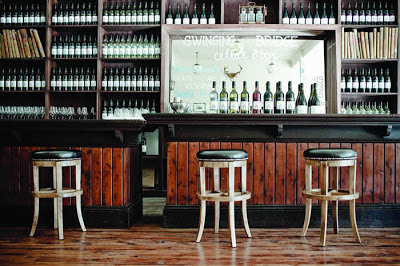
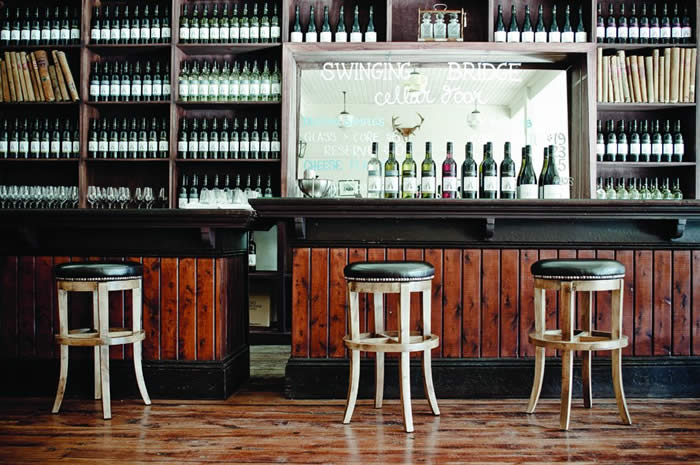
| The Swinging Bridge Cellar Door |
If I have to pick but one variety that most impressed me on last week’s little sojourn to the NSW wine region of Orange, it was Pinot Noir – a grape which, as I mentioned on Saturday, carries boatloads of welcome potential in a state crying out for more pinosity.
Beyond Pinot, it was unsurprising to see the continuing fine form of Orange Chardonnay, again reminding that this is one of Australia’s Chardy super hotspots. I like the regional style too – worked, but with great natural acidity, making for refreshing wines of some complexity. If I wasn’t a freeloading, blood sucking media-type, it would be Chardonnays that would follow me home for sure.
On another note, what was also interesting was how many winemakers were actually hanging around cellar doors, even on the weekend. Admittedly I focused on the smaller estates, but even Philip Shaw was wandering around in the cellar door garden on a Sunday. Clearly no rest for wicked winemakers…
Now, a quick admission – in this post I’m only covering 5 Orange producers, so I’d hardly call this a lifestyle mag-esque, ’10 cellar doors to visit in Orange’ guide. More of a quick look at a few notable local makers.
Ross Hill
Curiously, I’ve had the Ross Hill Cabernet Franc numerous times over the last 12 months, yet always seem to skip the most recent releases from the rest of the range. Glad to have rectified that situation.
Ross Hill makes two two different ranges at their converted apple packing shed (a common theme in Orange apple growing country. Those old apple sheds are well insulated and comparatively well priced for anyone looking for a well suited winery building), with the Family Series the $20ish, approachable line and the Pinnacle Range the wild fermented (even the Sauv is wild fermented, which is unique for the region), premium wines. It is the Pinnacle Range where the interest lies here, although the Family Series Shiraz at $22 looked very handy indeed.
On the day I visited James Robson, son of founders Peter and Terri Robson, was hobbling around to show us the immaculate winery (complete with centrifuge and cross-flow. All the toys), his hobble caused by a morning of cycling and running. All those wonderful hills, you see, mean that everyone rides in Orange.
Of the wines, I thought the hand picked, whole bunch pressed (into barrel) and wild fermented,
2012 Pinnacle Series Chardonnay ($32) to be the standout, its balance of winemaking derived complexity contrasting nicely with the pristine natural acidity.
The 2011 Pinnacle Series Shiraz ($40), which was again handpicked, wild fermented and had 40% whole bunches, looked also very fine, the white pepper Rotundone hit a nice counterpoint to what is a pinot-esque, red cherry palate. Lovely fine tannins punctuated this red, the mid-weight style a very clever iteration of modern cool climate Shiraz.
Interestingly, the 2011 Pinnacle Series Pinot Noir ($36) didn’t carry that same composure, the wine carrying the slightly heavy, bacony, dry reddish style that some of the Orange Pinots can show. Interestingly, this wine (as with much of the Pinnacle Series wines) drawn from the cool Gilbert rd vineyard (down the road from Bloodwood), which sits at 750-850m altitude and was described to me by another winemaker as a ‘minty site’ (make of that what you may) and not really suited to Pinot.
It is the 2010 Pinnacle Series Cabernet Franc ($36) which is perhaps the most widely talked about wine in this range, often considered amongst the best Francs in the country. I can certainly see why – it’s an impressively varietal Cabernet Franc in a nation not known for varietal Cabernet Franc. Personally, I was a little torn by it, as I do really like the redcurrant and hedgerow nose (no cinnamon this vintage though. Just in the 2009) and that sense of freshness to the palate. What I’m not as convinced by is the minty, slightly underripe tannins, which, ultimately, make for a somewhat awkward finish to what is otherwise a wonderfully distinctive wine.
Amongst the other Ross Hill wines, I thought the 2009 Pinnacle Series Vintage Brut ($36) was a bit broad, the 2012 Pinnacle Series Sauvignon Blanc ($27) nicely textural and defined, and the 2011 Pinnacle Series Botrytis Riesling ($22) a little simple and heavily botrytised but certainly packed some some intensity.
With more fruit coming on from the high (1050m) winery vineyard soon – and the promise of new super cool some promising wines to come with it – you can just feel that this is a winery on the up. Oh, and they also grow cherries, just in case you’re about in cherry season.
De Salis
I ended up at De Salis on the back of a few recommendations really, as they have almost no presence in the retail/on premise market bar a few notable Sydney restaurants (Stu at Fix St James, Emma and crew at Rockpool on George amongst them), with over 90% of sales direct through the cellar door (or mailing list).
Much of what makes this estate so successful (from both a wine quality and sales perspective), is the fervour of the people behind it. More correctly, it is the fervour of former Sydney scientific researcher Charlie Svenson, who drives the business, along with wife Loretta. It is Charlie who carries the unquenchable enthusiasm of someone with a restless scientists love of wine’s permutations, with also wine-smitten Loretta also clearly helping to keep Charlie in line.
Charlie, like so many Orange vignerons, gave up on a Sydney life after catching the winemaking disease back in the 90s, with the end result of many years making wine in Sydney garages and the like, ultimately leading to the purchase of the (ideally situated) Lofty vineyard. It was not without trying to find this perfect site, with Charlie also coming close on several sites in Orange, particularly the neighbouring Forest Edge vineyard that supplies fruit to Brokenwood (although Charlie lost out there).
What excited him with the Lofty vineyard was the near perfect geography of the site – north facing, gently sloping and situated at 1050m on the northern side of Mt Canobolas, the vines planted in a basalt over limestone soil in 1993 by noted local plant man David Gartrell. While the vineyard’s initial (and indeed ongoing) focus was on Cabernet Franc and Merlot, it is Pinot Noir, Chardonnay and sparkling wines that Charlie throws his soul into, a situation that leaves the vineyard’s large, arguably unsuitable (in my opinion), Merlot plantings in danger of grafting in the years to come.
Following in that sentiment, it surprised me little that the best wines here were from Pinot Noir. His 2011 Lofty Pinot Noir ($65) I will officially declare to be among the finest Pinot Noir based I have ever had from NSW, the wine carrying that unmistakable lip smacking, almost fizzy acidity that Pinot Noir planted in cool sites over limestone seems to show. It’s an acidity that I’ve only really seen in Waipara/Canterbury in New Zealand and, indeed, is also rare in Burgundy. Magical acidity that.
Beyond just acid, the reason why this wine works is all about the tinkering scientist growing the grapes and making the wine. A tinkering scientist who can’t help but experiment..
That 2011 Lofy Pinot Noir is thus produced from four different clones, the grapes picked over a 3 week period with varying levels of whole bunches in the ferment, the wine treated to very long maceration times and no temperature control. The end result is a stunning, full, powerful and structured Pinot Noir that is unquestionably ripe (that altitude also tends to increase ultra-violet light exposure, helping push along ripeness) but retains delicacy. Brilliant stuff and well deserving of its multiple trophies.
Standing in the shadow of this wine is its brother, the 2011 Pinot Noir ($45) which, curiously, looked riper, heavier and a little less defined. In the context of the region its still a very good Pinot Noir but lacks the x factor structure and length of the top wine. A hard act to follow.
When I was there, Charlie spent several hours jumping over barrels in his busy apple shed winery, dragging barrel samples of all sorts of different wines, yet it was the components of his unreleased, still on lees, sparkling wine that made the most impact. A single barrel of Pinot Meunier, for example, was so arrestingly delicious that I started chiding him into releasing a single Pinot Meunier wine (bubbles or not). Given that there was a tank of fortified Orange Shiraz in the winery (which was picked at 15% potential alcohol), I wouldn’t be surprised anything come out of the De Salis winery.
While they didn’t quite have the same impact, the other wines in the range did showcase the site nicely (even if I remain unconvinced about the varietal suitability) with the 2011 St Em F ($42) and the 2011 St Em M ($38) (a Cab Franc and Merlot blend Bordeaux blend) both carrying some wonderful spice and beautiful tannins, even if they felt a little pointed and minty at times, the Cab Franc blend easily my pick of the two.
The only wine I really didn’t fall for, in context, was the 2011 Chardonnay ($35), which looked backward and a little too lean. Chablis-esque for sure, but it did taste an awful lot more like the aforementioned sparkling base than anything else (which is always a problem when you’re in a sparkling mindset)
Rounding out the range is the 2011 Fume Blanc (now sold out), a wine that is more fume than Sauvignon, built more the modern Kiwi ‘hold the herbs’ style than many other Orange Sauvs. Lovely texture too. I can see why it is so popular at the cellar door.
Speaking of cellar doors, I’d easily rate De Salis as the most welcoming cellar door of any that I visited, no doubt pulled along by the infectious, fanatical enthusiasm of Charlie and the welcoming nature of Loretta. Obviously I received the ‘media’ treatment, but even the casual visitors that turned up as we chatted (for hours. Charlie can talk. I can listen. I ask lots of questions. Charlie liked answering them) were given a personal experience.
Well worth a visit.
Swinging Bridge
The caveat for this entry is that Swinging Bridge’s winemaker, Tom Ward, is a friend, so naturally I was here more to chat with him than really to be digging through the Swinging Bridge range. Indeed, I’m not even the biggest fan of some of the standard Swinging Bridge wines, with the sub $20 whites just a little one-dimensional for me to really love.
It is with the Reserve range, however, that things really start to get interesting, the 2010 Reserve Shiraz ($45) – produced from Canowindra fruit, which makes it a ‘Central Ranges’ Shiraz – is a welcomingly dense and firm red in a region that isn’t always known for wines of generosity. It feels long, dark and concentrated without losing spice. Imagine Mudgee-like levels of extract, yet without the Mudgee mud.
Speaking of Canowindra, it is this little town, some 60km outside of Orange, where Tom calls home, with his wines sourced from his own local vineyard, as well as those of growers in Orange.
Unlike (somewhat) flashy Orange, Canowindra feels more like a sleepy country town, with a reputation more for hot air balloons than anything else (it bills itself as something of a ballooning capital). With generations of family history locally, Tom is particularly focused on making this little sleepy town a little less sleepy, with his cellar door based in a wonderful old historical general store that was setup by in the 1870s by Tom’s great-great grandfather.
As for the rest of the Swinging Bridge wines, it is indeed another red that really stands out as a highlight, with Tom’s unreleased 2012 Reserve Orange Pinot Noir (sourced from the Rowlee vineyard on the road back into Orange) carrying a nice balance of authentic Pinosity and flavour richness while still retaining delicacy. Tom opened this Pinot up without telling me what it was, putting it alongside a (plain awful) Tumbarumba Pinot Noir from Moppiy that looked so very bad next to this wine that it was amazing. He’s (obviously) a clever man is Tom, opening up an inferior wine to compare with his. Even he didn’t expect the Moppity to be that ordinary though…
With any mate you always want to give tan honest appraisal, good or bad, and I can definitely see that his reserve wines in particular are evolving nicely. Just don’t tell him that (tell him I hated the wines. All of them).
Bloodwood
I’m really glad that I managed to pop into Bloodwood, as this estate is the pioneering winery in Orange, with Rhonda and Stephen Doyle so intrinsically intertwined with Orange’s wine history that not talking about them is like going to the Hunter and not talking about the Tyrrell’s family.
You can have a read of the Bloodwod history
here, so I won’t delve too much into that here. Instead, I want to talk about the Bloodwood proprietors Rhonda and Stephen Doyle themselves, for they are quite intriguing personalities (and they set the context for the wines).
On the one hand you have Rhonda, who loves textures, tastes and food, her predilection towards what to eat with the Bloodwood wines rather than any technicalities about their production, her manner genial and her imagination vivid.
In direct contrast, Stephen is gruff, grumpy and laconic, his sense of humour bone day and his wit wippet-quick. From first impressions, he seems perturbed by people, tired of the annoyances that goes with running a vineyard and winery largely on your own. Yet dig a little deeper and you can see that the dry humour reveals a similarly imaginative persona, his mannerisms seemingly bussling and angry, but belying a giving, if straight talking, personality underneath.
Indeed Stephen is something of a local mentor, having helped out half of the Orange wine industry over the years, including a stint as a local wine lecturer. He famously helped Philip Shaw to locate the right spot for his initial plantings in Orange, and even now lends advice to a range of different vignerons locally, in Mudgee and further afield. A true wine icon, if a somewhat reluctant one at that.
Ultimately, Stephen strikes me as a ‘call a spade a spade and an asshole an asshole’ kind of guy, a personality type that I think I can understand (as it seems very Australian). He’s funny too, deadpan funny. Not all can handle this sort of humour though, with Andrew Jefford, for one, apparently unsure of how to comprehend it when he stopped by on his recent terroir study tour, leaving Rhonda to field technical questions…
On my visit I rather tested the boundaries of Stephen’s personality too, as I (mistakenly. Stupid media-types!) spat out a sample of the brilliant, unbottled 2013 Bloodwood Riesling onto Stephen’s freshly acid-washed, drier-than-the-Sahara, about-to-be-painted winery floor. He yelled ‘you idiot, I’ll be down with a hair drier all afternoon now’ and looked at me with frustration. Yet, importantly, no malice, He is well used to people spitting in the wrong spot I’m guessing…
As for the wines, well, the Riesling really is one of the stars here, proclaimed – quite rightly – by Stephen as the sweetest dry Riesling around. It looks wonderfully sweet-but-dry too, a genuinely generous, yet sufficiently acidic, wine of thrust and softness. A multi-faceted wine from a multi-faceted winemaker.
Also in the whites, the 2009 Schubert Chardonnay ($32) is also an utterly delicious wine, the acidity so initially blinding and firm that it looked a little awkward until I gave it a nice big swirl. Real acidity that, the wine crafted with no malolactic fermentation and plenty of ‘work’ in the winery, a style that Stephen believes pre-dates the current fashion towards lean-but-worked Chardonnays. Could this be the sort of a wine that was once held up as the future of Australian Chardonnay? Stephen thinks so.
Beyond Riesling and Chardonnay, the focus here is still on the Bordeaux reds (plus the odd Pinot Noir and Shiraz), though my favourite of the reds remains a blended wine. The 2008 Maurice ($35) is something of a ‘best barrels blend’ containing an unspecified (Stephen was vague about proportions) blend of Cabernet Sauvignon, Shiraz, Cabernet Franc and Merlot, the resultant blend much more together, mid weight and lengthy than its disparate components might suggest (though Hermitage always made its way into Bordeaux eh?).
Other than the blended wine, I did struggle somewhat with many of the other reds, the linear 2007 Cabernet Sauvignon looking a little incomplete, the straight Merlot also looking like half a wine. It wasn’t until I hit the 2008 Malbec ($30) that things started to make more sense. This more generous, more mid palate driven variety looked approachable in a line of somewhat stubborn wines, it’s lighter tannins helping to make it all the more drinkable. Nicely varietal it was too.
Overall it was an intriguing stop at Bloodwood, made ever more intriguing by the people themselves. Again, if you really love you’re wines (and if you’ve made it this far down the page, I’m guessing that’s an emphatic yes), then this – and De Salis – should be your two must-do stops. They’re worth the appointments if you’re looking for character.
Philip Shaw
The flashest cellar door, the most cleverly packaged wines, the biggest vineyard. You’d be forgiven for expecting quite generic wines at Philip Shaw, yet this stop was still entirely valid, if just to walk through the wines after so many more-boutique products. They stack up too, for a variety of reasons.
Most importantly perhaps, it is Philip Shaw were I found the best value wines on this little trip: The 2012 No. 19 Sauvignon Blanc ($25) is a very good example of the snappy, crisp, varietal, lets-beat-the-Kiwis-at-their-own-game style. The 2012 Architect Chardonnay ($20) is simply superb drinking, matching length and fruit weight with acidity, making for what I would call amongst the best sub $20 Chardonnays around (it’s that good). Similarly, the 2011 Idiot Shiraz ($20) was a startlingly good, finely spiced, cool climate Shiraz and the 2012 Wire Walker Pinot Noir ($20) a perfectly executed, Pinot fruit-sweet Pinot Noir that actually tasted of Pinot.
Much of the corresponding wines in the ‘Number Series’ (I’m calling them that) range look at least solid too. I thought the 2012 No. 11 Chardonnay ($35) looked a bit gangly but certainly shows much future potential, with the 2011 No. 89 Shiraz ($35) looking tight, but well composed, with spicy whole bunch wildness and a certain richness to match up with it.
The only wobble with this winery? Philip’s absolute belief in Bordeaux varieties. The 2010 No.5 Cabernet Sauvignon ($75) is just a one dimensional beast, its linearity not really delivering much else besides tannins and cedary varietal characters. Obviously it’s billed as a long term prospect, yet I can’t shake the slight astringency of the tannins and the lack of real fruit ripeness. The general sensation of ‘this isn’t the best variety for the site’. I wasn’t enthused by the 2011 No.17 Merlot Cabernet Franc Cabernet ($25) for that matter either, it’s mid-weight style just a fraction too angular and awkward looking, despite the mid palate generosity of the Merlot hit, to be really satisfying.
To be honest I’m probably nitpicking, as the quality of this range is really very high. Yet it did irk to see Merlot and Cabernet again put on a pedestal, when,
as I babbled on at length about here, it just doesn’t feel right (or suit climatically).
Overall verdict on Philip Shaw? A worthy stop if you want consistency. A good yang to the ying of De Salis or Bloodwood and polished wines for sure.



Leave a Reply