

It must be tough being a ‘big’ Australian wine brand.
Locally, you’re faced with an openly hostile, supermarket-dominant market where supermarkets are at war with each other and view suppliers as cannon fodder and Australian wine consumption is flat at best. Then, to make matters worse, exports are also on the slide in all three of the largest major markets.
Obviously those are industry-wide challenges, but when you’re on the volume end of wine production, they’re inescapable.
Still, some of the bigger wineries manage their business better than others. Penfolds, for example, are the gold standard, with Treasury treating this sacred cow more and more like a luxury brand – and (arguably) doing much better for it. Conversely, Rosemount or Lindemans are perfect examples of big brands that have been poorly managed and are now mere shadows of their former selves.
Jacobs Creek, however, is different. I’ve said previously that JC are one of the more innovative big brands in the land, and they are unquestionably clever when it comes to product development. Yet sometimes wines come out that are more about price positioning than innovation or quality.
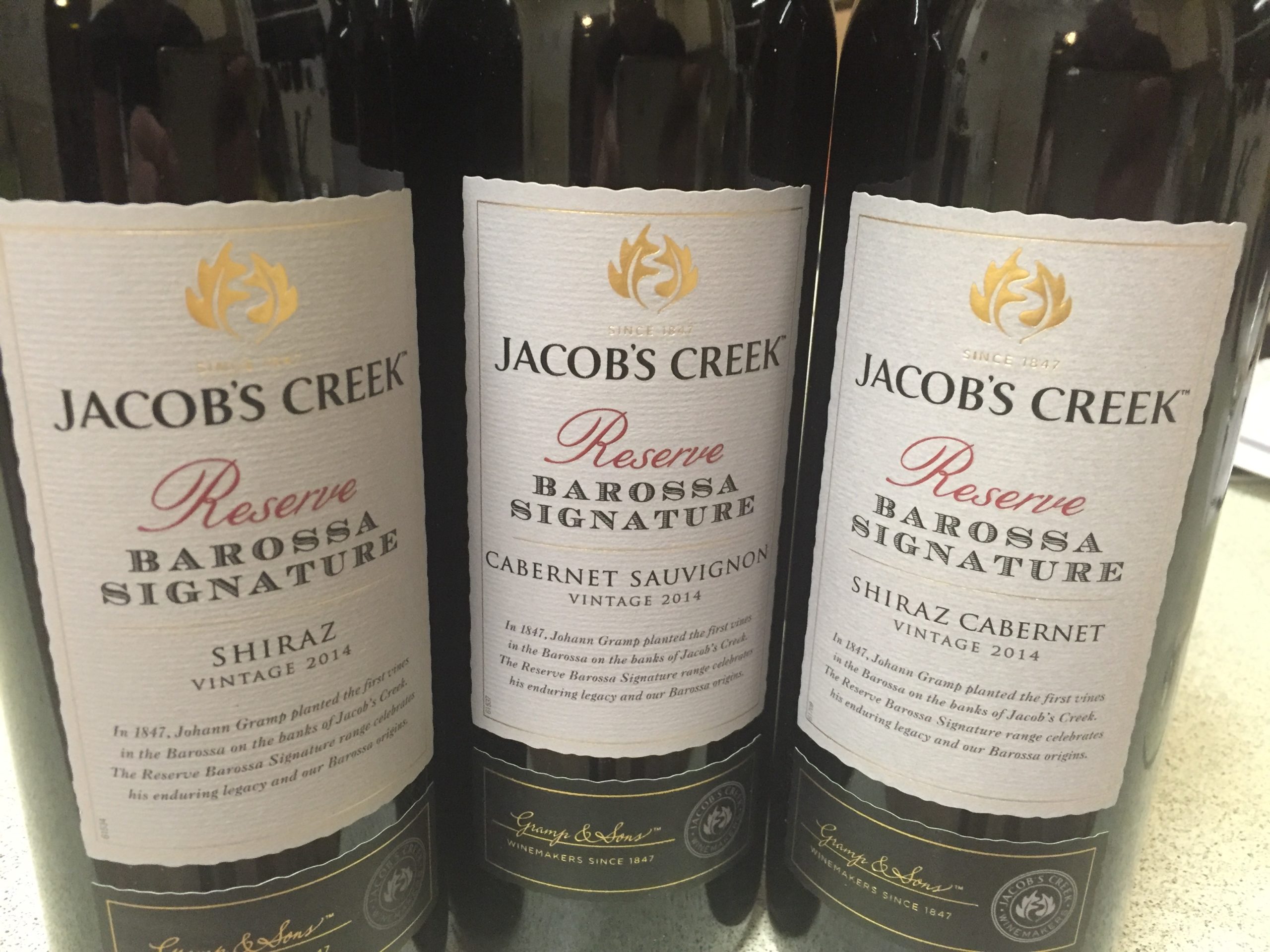
That’s where, I think, this new Jacobs Creek Reserve Barossa Signature range fits.
Over the last few years we’ve seen Jacobs Creek’s ‘Reserve’ range of regional wines become a discount favourite, often used by retailers as a loss leader to bring people through the door. I don’t blame them really, the range is reliably good (particularly the Chardonnay) and customers love ’em. But what it has done is drag the ‘real’ price of the JC Reserve range down from the $19 RRP to circa $11.99/bottle, with the expectation then that retailers will also pay less for the wines.
While that’s all fine and good if you can keep costs low, it’s unsustainable when Barossa Shiraz (which would likely be the most popular wine in the Reserve range) grape prices are at record highs.
Of course I’m speculating, but I’d wager that such conditions helped kick off a rethink in the pricing, and ultimately bred the Reserve Barossa Signature range – an exclusively Barossan range of reds, focused on Shiraz and Cabernet Sauvignon.
To be honest, it makes quite obvious sense to have an all-Barossa RRP $19.99 red wine range when you’re a Barossa winery, and you could argue that it’s long overdue given JC’s history. But I’m still, perhaps cynically, calling this as a move as much about pricepoints than anything else.
That’s not to say these are bad wines. ’14 was a slightly tricky vintage in the Barossa, with some serious heat and then a crazy storm on Valentines Day. But the better wines are certainly good, and this trio is at least representative, even if the only wine I’d recommend is the blend.
The only question really is what you think – is this range clever or just filling a hole?
The wines
Jacobs Creek Reserve Barossa Signature Shiraz 2014
Up to 18 months maturation in ‘selected oak’. TA 5.8g/L, pH 3.68.
Rich and hearty, this deep red (with purple edges) coloured wine has a plummy nose with just a hint of scorched fruit, the edges lifted up by a little milky caramel oak with a soft, generous, medium weight palate and slightly sweet plum finish. There’s some good chew here, but it ultimately feels a bit stewed and raw to get much higher points. Should improve with 12 months in bottle. Best drinking: 2017-2024. 16/20, 87/100+. 14.5%, $19.99.
Jacobs Creek Reserve Barossa Signature Cabernet Sauvignon 2014
Sourced from the valley floor and Eden Valley. TA 6.2g/L, pH 3.58.
Red with just a little purple, this is the weakest of the trio with vegetal notes and a sweet and sour palate. It’s varietal, but shows that Barossan Cab tendency for mixed ripeness, the tannins a little astringent too. I didn’t enjoy this much. 15.8/20, 86/100. 14.3%, $19.99
Jacobs Creek Reserve Barossa Signature Shiraz Cabernet 2014
pH 3.59. The tasting notes give a TA of 3.63g/L but I think they’re drunk.
The best wine of the trio, this is deep red, with less purple than the straight Shiraz. Here, the open berry flavours are supported by more tannin and more structure, all of which helps make it look complete and more satisfying than the stewed Shiraz. There’s a little confection on the tail, but the package otherwise feels quite complete as a simple, hearty, Barossan red. Best drinking: 2017-2027. 17/20, 90/100. 14.5%, $19.99.


Leave a Reply