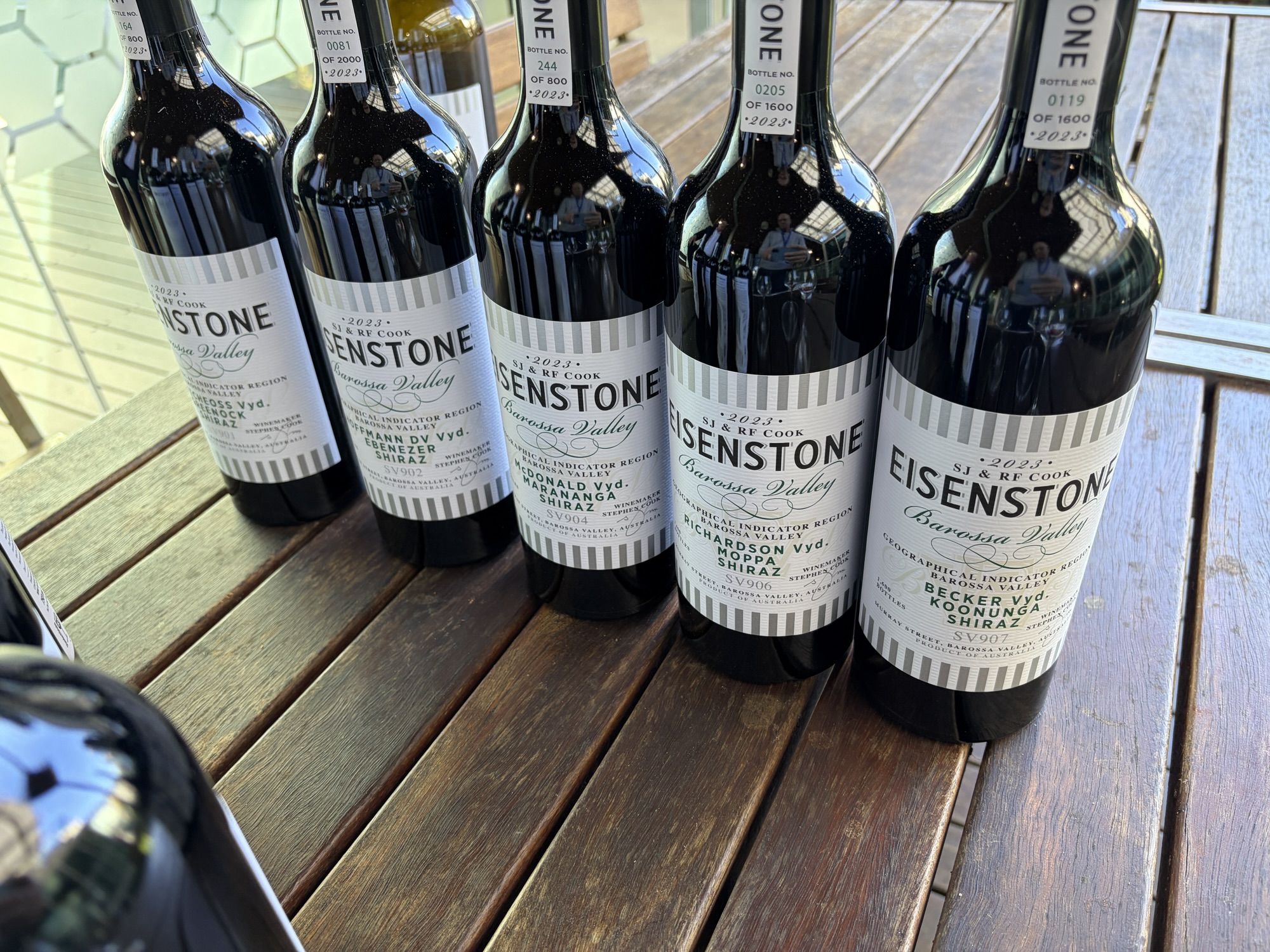
As I sit with a thick bottle of the new Eisenstone SV902 Hoffmann DV Vineyard Ebenezer Shiraz 2023 in front of me, I keep thinking about how refreshing it is to see how Barossa Shiraz has evolved. The default setting hasn’t changed; this wine, and the style is still unashamedly lush, oaky, and warm, but we’re no longer stuck with the old-school four-square, American oak-heavy styles as the only way.
Close followers will know how much I like Stephen Cook’s Eisenstone wines, and it was a pleasure to see Stephen on a brisk July day recently to see the ever-growing range of Barossan goodies.
Before we get stuck in, it’s worth spelling out again why (or skip ahead if you’ve heard this story) I like this range. All Barossa Shiraz (Eden Valley Chardonnay next), the Eisensstone wines made the same way across the whole range (maturation in 40-50% new French and American oak for 18 months to two years, with more wood for the SV wines), and all bottled in individual parish/vineyard bottlings.
What also places these Eisenstone wines up high on the ladder is the fruit source, with Stephen uncoincidentally tapping into some ex Grange vineyard sources, and Adrian Hoffmann’s legendary Dallwitz Block at Ebenezer,
While very normal in the modern sense, in a world of single-vineyard hero wines, this terroir-driven approach is somewhat historically rare for the Barossa, where makers like Penfolds, St Hallett, Rockford, etc made a name for themselves on pure regional styles, rather than any notion of sub-regions or single vineyards.
It’s Champagne vs Burgundy, if you want an old world parallel. Or old school vs new school Barolo.
Of course, it was makers like Penfolds that first did the Barossa single-vineyard super-wine thing with Block 42 (or Henschke HoG). And muddying the waters is how attempts to make sub-regions within the Barossa are so politically fraught that they go nowhere (let’s not even talk about the bullshit around the naming of Kalimna).
Interestingly, these 2023 vintage releases have a certain sleekness to them too, which Stephen sees as a vintage character. It also makes these 2023 wines a decant-for-best-results proposition (I had a glass from one bottle opened 24 hours and it was more complete). Some in this lineup look a little blunt, but the next-level flavour layers are what marks everything.
Let’s have a squizz! Note that SR is the parish (unofficial sub-region) wines, and SR is the single vineyard releases.

Subscribe to keep reading
This is not a paywall. Subscribe for free and you get email updates and I keep AI out.