

Between Five Bells – stylish new Geelong wine
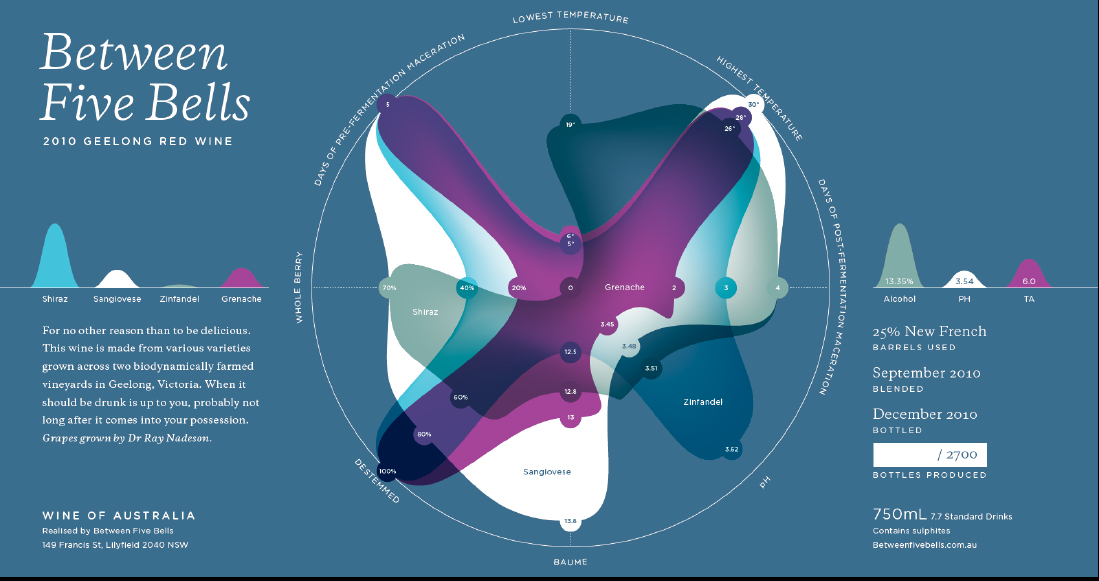 |
| Is this the best wine label in the country? (Click to view full size) |
If you’ve a chance, check out the Five Bells website. It’s not so much the structure of the clever website that’s worth a look, but more the images of the labels. Simply put, these are some of the smartest packaged reds I’ve seen in many moons.
Drilling down further, it’s the information on the label itself that is particularly notable. Ferment temperatures, maceration level, proportions of whole bunches, everything. Eight different sets of data, all represented via some clever graphical waves. What makes it even more clever is that, unless you look very closely, you’d never realise that the graphics are actually data representations. In fact you’d probably just pick it as a bunch of flowing coloured waves unless you had a closer look. Suffice to say it’s glorious, cutting edge stuff, particularly for a wine geek like me. I love it.
The grape sourcing of the wine too is equally classy. Grapes all come from the Geelong GI, off the biodynamically farmed Lethbridge home vineyard (planted in 1996) and the Rebenburg vineyard at Mt Duneed (planted in 1970). What’s of further interest though – and here is where things get truly offbeat – is the blend itself. Shiraz is the main component, followed by Grenache, Sangiovese and a little Zinfandel. It’s a very unusual blend for Geelong and looks it too. It’s clearly well thought out (have a squizz here), but, for mine, I think it’s not a particularly cohesive one, with the Shiraz having some runs on the board, but the rest looking like bit players (such as cool climate Grenache, which so very rarely works). Hey, it’s their first vintage though so slack should be cut.
But back to the story. The winemaking here really deserves a big mention – it’s as happily ‘old school revivalist’ as possible. Pigeage, no temperature control, plenty of stems, everything. Again it screams of attentive winemaking, of an unending desire to make great wine and a ‘who cares about the risks’ philosophy. It’s admirable stuff. No, it’s more than that, it’s the sort of winemaking style that I’d chose. High five David Fesq and co.
Now, to the wine. It’s a provocative thing that’s for sure. It smells of candied, sherbery cherry fruit, the carbonic maceration from plenty of whole berry action giving a wildly juicy, pink musk and strawberry sweetness that fairly jumps out of the glass. If anything it’s almost too sweet, too pink Lifesaver candied and a little frivolous for me personally but it certainly makes for a very pretty wine. The whiff of stemmy seriousness also suggests that with more bottle time it should settle down with a little bottle time.
From here the palate is a darker affair. It carries a thicker, cherry fruit and veal savouriness and some twiggy bitterness, making for a clever and nicely layered palate of some intrigue. In fact the only downer is that it lacks persistance, the finish a little skinny, skittish and almost young-vine lean. I hate to hang out my prejudices, but I’m laying that at the feet of the Grenache and Sangiovese in particular, both of which really need to come from old vines in the right spot to work (in my opinion).
Still, that’s but a wobble for this project. A wobble that will no doubt be tamed with an extra vintage or two under the belt. Regardless, like the special white wax (which has to be specially imported) that the bottles are sealed with, this is a particularly individual wine from one seriously exciting project…

Leave a Reply