Things are pretty wobbly in the local wine industry right now.
Whether it’s grape growers protesting unsustainable fruit prices on the streets of Renmark (where even Shiraz is going for just $150/tonne – 1970s prices), the drop in export value (again), or the half-baked One Sector Plan that promises to encourage more committees instead of action.
Indeed, I’ve never seen so much wine available at discounted wholesale and from producers who I’d never expect to see a discounted wine. There are oodles of producers still trying to sell 2022 white wines as 2024 vintage grapes hit the crusher, with little relief on the horizon.
If ever there was a time to get out there and drink some wine, it’s now.
Of course, it’s not all troubled waters out there in local wine land either…
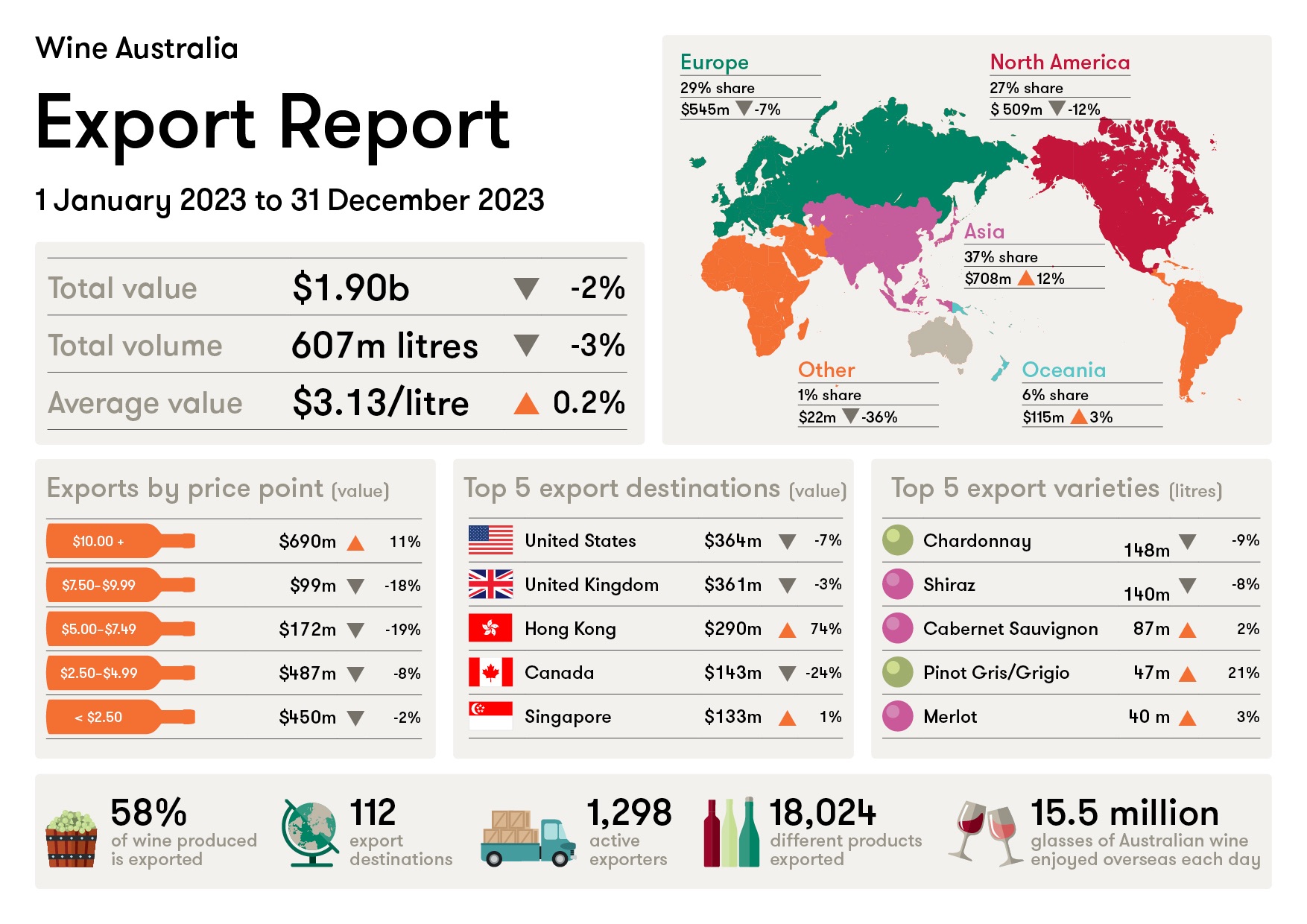
Look, for example, at the resilient demand for the premium/luxury end of the market (ie above $15AUD, which is hardly luxury, but we’re talking export numbers here, so take off 40% tax), even if there are anecdotal reports of people ‘trading down’. Exports indicate the premium uplift as well, as the Wine Australia graph below shows.

Cross over the ditch into NZ and Kiwi wine exports are also surging along at 23% growth, and when coupled with some lean vintages, prices are actually going up.
Locally, while inexpensive Shiraz & Cabernet blend might be a harder sell than usual right now, top-tier Pinot Noir isn’t, with prices also up 7% in value (I’ve dived into a few new Pinot releases this week, too, so its front of mind).
That won’t help McLaren Vale producers, however, with the region’s Shiraz exports down 28% YOY (according to Wine Australia figures). Vale Cabernet Sauvignon is faring even worse, with exports down a giant 42.2%. That’s tempered by a 2% lift for Grenache (you can view all the export numbers here), but given that Shiraz and Cabernet makes up 74% of grapevine plantings in the region, you can understand why there is some suffering.
I don’t want to pick on McLaren Vale, as that’s just one regional example. But it’s one GI hit notably hard by a drop in exports (although the Barossa isn’t too far behind), with the resultant rise in winery stock putting pressure on business viability.
McLaren Vale winemakers could do with your love (and so could Riverland grapegrowers).
As if that’s not enough, local craft brewers are struggling too. One of my favourite local breweries (Hawkers) went into voluntary administration last week, joining many brewers who’ve gone down recently. Thankfully, Hawkers will likely live on, but the brewing industry problems are spreading, not helped by the explosion in faux craft beer (and spirits) now dominating retail bricks and mortar liquor.
Ultimately. this weekend, you can do your bit – have a schooner of local indie craft beer, and follow it up with a great McLaren Vale Shiraz (like this one just as a starter) and do your country a favour.
Help keep this site paywall free – donate here

7 Comments
Isn’t this a reflection of too many producers in the commodity end of the market where they’re competing with increasingly vertically integrated retailers sic. Endeavour drinks and Dan Murphy’s.
I rarely buy a wine under $20 so I”m automatically buying in the top 10% and even some of that is dubious quality….
More about outside factors (loss of major export markets, global flat consumption, rise in costs not translating into increased wine prices) that is the issue. There’s no question that we have too much vineyard land, however, but the reduction to get to a more realistic volume is going to be long and hard
The Draft One Sector Plan, was just that a draft document, generated after wide industry consultation.
It was always intended to be worked upon further after it came out for comment.
However, if the wider industry thinks that a document is going to save them from themselves, they have rocks in their heads.
Its not just the warm irrigated inland regions that are causing the problem, its the oversupply everywhere that is causing the issues. I mean you can purchase Adelaide Hills GI Shiraz or Coonawarra GI Cabernet Sauvignon for $500/tonne. No one wants it!
Grapegrowers and winemakers need to recognise that they are producing something that is really a luxury at the end of the day. The industry has always worked in reverse, growing something and making it into a product 1st and then trying to find a market for it. It needs to be finding the market, making what they want and then growing the fruit to suit those requirements
Its bonkers!
Agreed Peter, the industry has it the wrong way around, where we just make wines and then (hopefully) find a market for it. Also reflective of how inherently conservative the wine industry is – look at how much rage is still directed at natural wine, rather than seeing why lo-fi styles are winning over young drinkers. Bonkers indeed!
I hate to say it but the 40% WET tax is encouraging laziness.
No such thing across the Tasman and their industry is in better shape than ours.
In reply to Richard above, I couldn’t work out the missive in your post so did a bit of reading. WET is a tax that some folk cop, but I couldn’t understand your comment about ‘encouraging laziness’. A tax is a tax and at 29per cent, it’s a lot. But I found this –
The WET applies to the last wholesale sale. If a wine producer sells to a wholesaler /
distributor who will, in turn, make another wholesale sale to a retailer, the wine producer
does not incur a WET liability as long as the wholesaler quoted their ABN. This also applied
to Customs collections – the WET may be applied to the Customs value of the wine imports,
but not if the product is to be on-sold at wholesale.
So are you suggesting the laziness in the vineyard is because the owner will flog his stuff to a wholesaler and hence save himself the WET liability? Therefore he may not strive to become the end retailer and would have to pay WET but gets rid of his stuff to someone else?
Am i getting the concept right here for laziness? It’s a new thing for me even though it’s been around since
2000. In terms of comments above about heavier style reds from certain regions, aren’t the big boys like Penfolds and Wynns happy they have their markets in check and know how to sell their stuff. It aint cheap but it sells.
The serious red drinker is certainly in decline in Australia as taste buds change. Look at whats trendy out there and it does change. At the end of the day, I only taste two types of wine. Good or Bad. However these days that isn’t good enough. I did notice 3 W.A. vineyards went down recently, West Cape Howe or something like that was one.
Salute mon amis !
I think Richard is more alluding to the WET rebate, that allows producers to claim up to $350k per year back. It means that winemakers who stay small can effectively make a 29% margin.
As a tax, however, WET just disadvantages premium wine.