
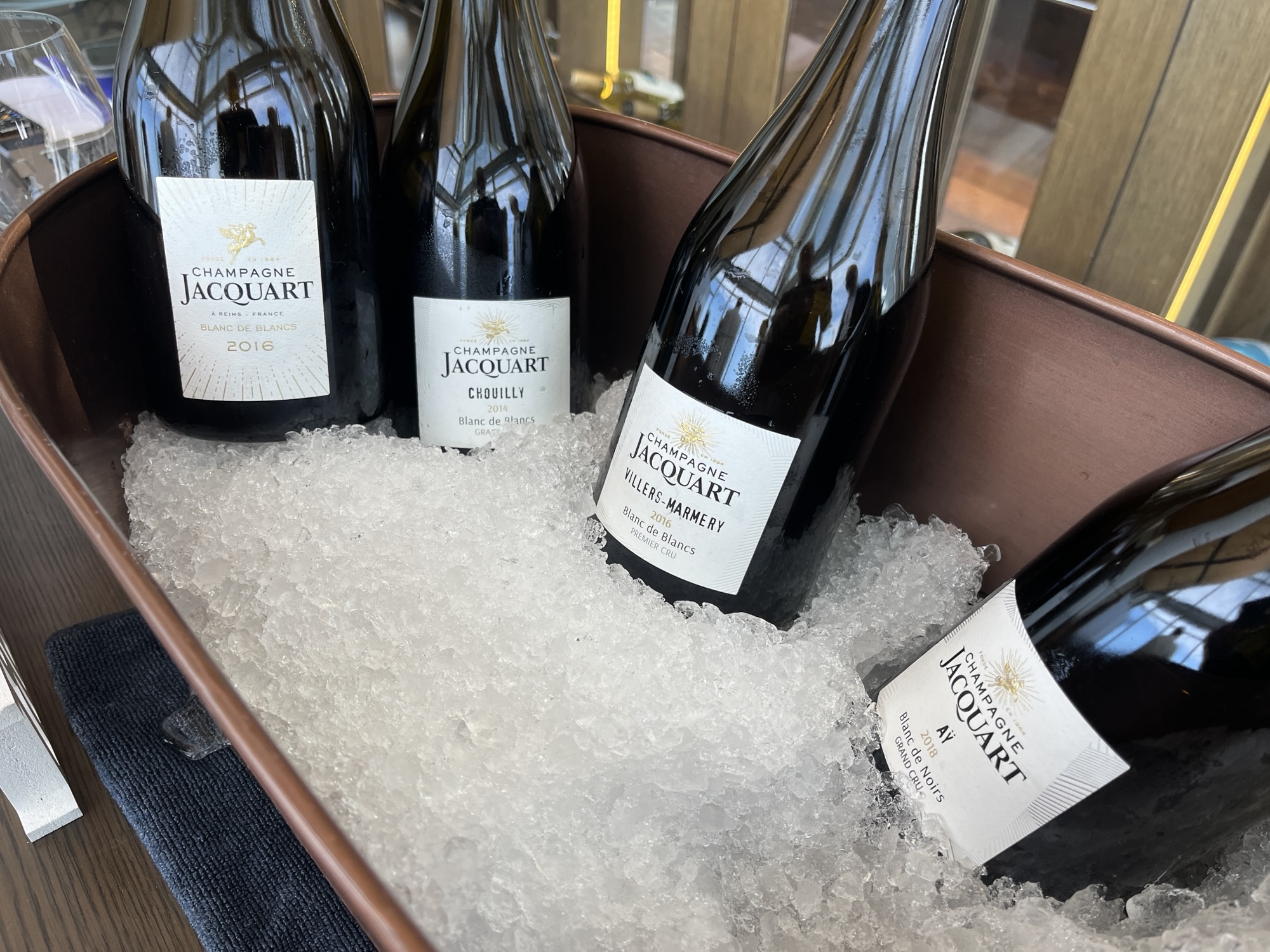
The 35th floor of a Sydney hotel feels the right place to launch a new range of super cuvées. Peering down at Darling Harbour on a super Sydney day from the cosseted surrounds of the Sofitel Club Millésime is the vintage Champagne drinking life, too. Sadly, it was my second tasting of three on a Tuesday, so all I did was scoff down the cheese and leave rather than linger, but the sentiment stands.
What’s interesting about the Jacquart Triple 1 Collection is that, for all the gloss, there’s honesty here.
This young Champagne house is a co-op, which means a ‘mosaique’ (which is the name of the best-known Jacquart NV) of growers own the business, rather than a more traditional ownership structure. Co-ops have a pretty wobbly history, largely centred around low-tier volume wines, but a wave of fine exceptions delivers quality and consistency (like Produttori del Barbaresco, Cave de Tain, Domäne Wachau, etc). Jacquart started in 1964 with thirty (mainly Chardonnay) growers, and now that number tops 1800, although it is only more recently that the house has really projected that it was a co-op. MD Sébastien Briend (who was at the Sydney tasting), noted that ‘more (and more) we are communicating that we’re a co-op’, with an ethos that ‘the value should go to the growers’.
There’s a tidy resonance with this Triple 1 series, which is a collection of limited edition vintage wines that celebrate a single site, single grape and single year. Effectively, Jacquart winemakers select their favourite grower parcels to celebrate, choosing from over one hundred and fifty plots across sixty different crus, with some involvement from the growers, who also collectively pick their favourites. The plots aren’t necessarily Grand or Premier Cru either, so it’s a pure quality thing (if also a winemaker’s plaything), with winemakers not beholden to any cru in any year.
Stylewise, the mode here is about purity, with no oak used in maturation and not all parcels going through malolactic fermentation. Interestingly, the dosage on these wines sits at 7.5g/L which is slightly higher than the norm for modern grower fizz (which is usually sub 5g/L), although I didn’t notice overt sweetness at any point.
Let’s take a squizz at the wines:

Subscribe to keep reading
This is not a paywall. Subscribe for free and you get email updates and I keep AI out.

2 responses to “Champagne super-cuvées with honesty – the Champagne Jacquart Triple 1 Collection”