Making super premium fizz in Australia is a thankless task.
Despite the obvious quality, there comes a tipping point in pricing where local wines are endlessly compared to Champagne (I unconsciously do it all the time), and the French have a few centuries of history, a juggernaut of dollars and brand cache that keeps Champagne on the front foot. I can only imagine the journey that local sparkling makers must travel to convince drinkers that top-end Aussie bubbles are worth it, even after all these years.
No one has been down that road for longer than Ed Carr. Mr Arras, the ‘Godfather of Australian sparkling’ and winner of Sparkling Winemaker of the Year Award at the International Wine Challenge, has been at it now for almost four decades, and even though his ponytail is long gone, he still bloody loves Aussie bubbles.
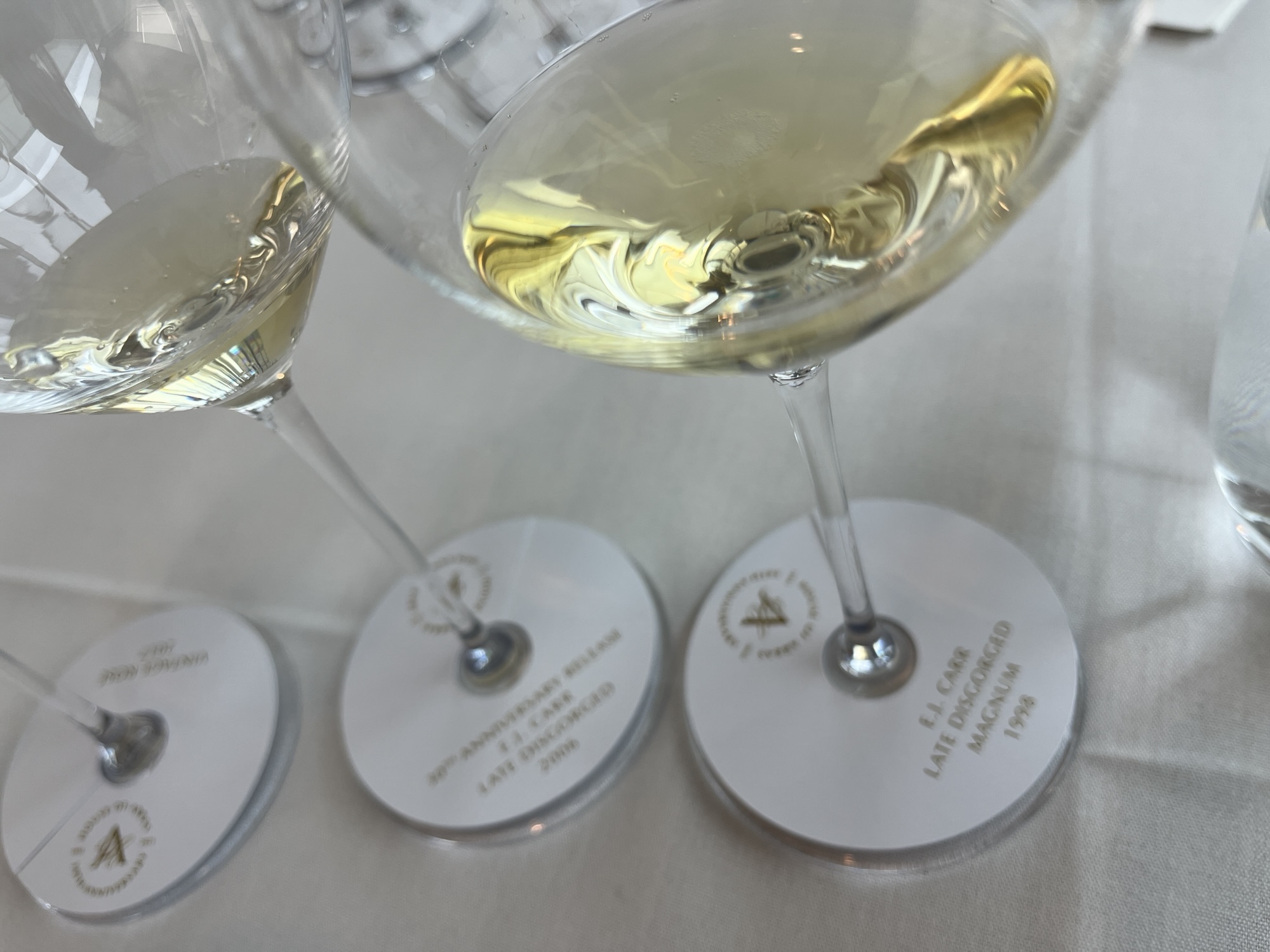
It really was a pleasure to see Ed in Sydney town recently (with a full bag of mature sparklings in tow) to celebrate what is now thirty years of Arras – or, more correctly, the House of Arras, but for this post we’ll stick to just Arras as the house bit always feels a bit naff.
What’s even more satisfying is that, after however many changes of ownership over the past three decades, Arras is now back in the hands of a supporting and enthusiastic backer in the form of William Dong’s DMG operation. As Ed calls it, this is ‘the renaissance of Arras’.
If I had just one takeaway from this tasting, held in the marbled halls of the NSW Art Gallery (a tody Renaissance link), it’s a message of complexity. Arras wines float above the rest because they are uniformly the most layered sparkling wines in the country. They’re not Champagne either; these are proudly Australian.
As Ed also said, ‘we focus on complexity and depth but also that vibrancy that we can squeeze into a glass’.
Before kicking in to look at wines and things, it’s worth revisiting the origin story. Skip ahead if you’ve heard this yarn.
The seeds of Arras were really sown (apparently) in 1988, when Ed was on a cool-climate wine tour of Australia’s less heralded (at the time) regions. The group visited Tasmania (and Tumbarumba, interestingly), which back then had just 46 hectares of vines and a mere handful of operators, despite vines being planted in the 1820s. To Ed, the promise was apparently obvious, even though it was still so such early doors. By the early 90s had become Chief Sparkling Winemaker at Penfolds, before then crossing over to Hardys in 1993 to help ramp up their sparkling program. With Ed at the sparkling helm, Hardys was soon started experimenting with fruit from all over the country, and acquired some Tasmanian grapes, which, at the time, Ed thought looked ‘fundamentally different’ to the mainland styles.
Arras was born.
As Ed explains, it could have been a multi-regional blend including mainland fruit, but the decision was made to back it in as 100% Tassie. It wasn’t until 1998 that the wines first broke cover and took the Australian sparkling world to a new level
I started in wine in the early 2000s, and it felt like the early era of a sparkling wine arms race. A gaggle of Champagne houses were investing in Australia, with Louis Roederer in at Heemskerk or Devaux with the Yering Station-led Yarrabank, let alone Moët going ever deeper at Domaine Chandon.
It also kick-started the focus on Tasmanian wine, taking plantings to now over 2,000ha of vineyards.
I reckon Ed knows all of those vineyards, too. He has a ‘master plan’ of fruit drawn from all over Tassie now, with 75 different parcels harvested last vintage. Interestingly, Ed doesn’t think the Arras winemaking has changed much over the years, compared to what is a step change at the vineyard level. In the winery, the maxim is still all handpicked fruit and only free-run juice, which is pretty classic sparkling fare (though there’s a surprising volume of pressings used in Champagne). Oak entered the equation in 2007, as Ed thinks oak maturation ‘has a big impact on structure’ and Arras started a traditional reserve wines program with wine stored in large oak foudre in 2016. Indeed, Ed is very enthusiastic about big oak, with now 20 foudres (and at $25,000 a pop, that’s a serious investment).
There’s some other interesting elements to the winemaking here too. Ed also embraces malolactic fermentation, which is increasingly restricted by other sparkling makers. He is also a big fan of cork ageing rather than just more time on lees as he sees that as ‘the third phase of sparkling wine ageing’. Arras uses individually tested corks. Finally, there are some occasional acid additions along with the dosage in these wines too, and every blend has a tailored dosage liqueur, before bottling using certified TCA-free corks.
You know what the only mental hurdle is when tasting these wines? They don’t taste like Champagne. This year, I’ve tasted more great French fizz than ever before (and went deep on my short visit back in April), which only helps entrench the style in my brain as ‘the’ benchmark. And the Arras wines are cut differently. The typically lower acidity, in particular, flows through your palate differently, especially compared to the low dosage Blanc de Blancs from the Côte des Blancs that I love so much. Instead, I see these Tasmanian wines as more about mouthfeel, with a little more generosity at the edges (and more ripeness), but with the compounding layers you’d see in ‘statement wine’ level of grand marque Champagne. Of course, I’m not about to get all parochial just because these are Australian wines and such. But the closer you look, the more it becomes apparent that the Arras wines aren’t lesser (and certainly not priced lesser FWIW), they’re just different and arguably more elaborate.
Ultimately, I like ’em, and I’m glad that thirty years later we’re at what is clearly an Arras high point.
Now, should we have a squizz at some wines?

Subscribe to keep reading
This is not a paywall. Subscribe for free and you get email updates and I keep AI out.