When you’re repping the wines from an entire wine region, every masterclass becomes political.
What wines are in? Which appellations get the most love? Who is going to present it? For a wine region as powerful (and political) as California, I can only imagine how many egos are driving every decision, let alone tracking the wines down here in Australia.
That, to my mind, has to be a few of the wines in this Californian masterclass – delivered by the clever and engaging Elaine Chukan Brown in Sydney recently – didn’t necessarily feel masterclassy. Representative of style and region, perhaos, but not always what you’d call the best of the Golden State.
And the best of California wine is truly world-class. The (over-subscribed) masterclass was held in a cramped room (with a huge pylon in the middle) at Sydney’s 12 Micron restaurant. That was one end of the venue, with the other end dedicated to a larger walk-around trade tasting that was heavy with engaging, big-name Cali Cabs, Chardonnay, etc. So, as much as I liked listening to Elaine’s insights, there was much better drinking to be had on those tables down the hall, even if I was fighting for a glass with the rest of Sydney’s sommeliers.
Pricing is the other stumbling block with American wines. Friendly, but hardly complex, white wines with $US30 pricetags does not affordable drinking make. Frankly, you’re not going to escape with something delicious and Californian in Australia without parting with at least $A100+, which obviously buys a shedload of local wine (let alone compared to European wines internationally). No wonder Americans fill their suitcases with wine when on Euro holidays.
No one else in the room seemed to want to talk about it (or perhaps care), but this event also came with a poison pen. The Californian winegrowers are obviously using events like this to expand into other markets (ie Australia), yet at the same time they’re actively pushing for increased tariffs on Australian wine entering into the US (read some of the attacks on EU and Australian wine subsidies here). There are some valid arguments about taxation, but most of it is just scapegoating for what is an unsustainable market structure.
Memo Californian producers – you can’t serve shit sandwiches with one hand and expect the sandwiches in the other to not be viewed with some suspicion.
Anyway, I’m ranting, let’s have a look at some wine. I’ve included rough US prices as a guide too:

J Vineyards Cuvée 20
From Sonoma County. 10g/L. Predominantly Chardonnay and Pinot Noir with a little Meunier. A slightly horsey and forward basic fizz with noticeable sweetness and an open, golden, creamed nut forwardness. Indifferent stuff and really lacking freshness – this tasted like entry-level fizz to me. Not a great bottle?
Best drinking: now. 16.3/20, 87/100. 12.5%, $US40.
Tablas Creek Esprit de Tablas Blanc 2020
Paso Robles fruit for this take on a Chateauneuf Blanc. Roussanne, Grenache Blanc, Picpoul Blanc, Bourboulenc, Clairette & Picardin in the blend too. Golden lemony mode with almond meal and lemon cake. A slightly pithy phenolic grip, the oak influence and bottle age introducing a broad, slightly cheesy expression that feels as much like aged Soave as a Rhone blan. Some nice, gently waxy, marzipan and lemon textures though. Can’t escape the phenolic bite though – it’s grippy, and only adds to the sweet and sour feel. An interesting wine this (as you’d expect from Tablas Creek), but the evenness and balance isn’t quite perfect.
Best drinking: now. 17.5/20, 91/100. 13%, $US65.
Au Bon Climat Nuits Blanche Chardonnay 2022
From Santa Maria Valley in Santa Barbara. Oak-shaped, but that’s also part of the schtick. Custard cream, vanilla, a real winemaker’s toolbox with creamed nuts and layers of biscuits and rice pudding. It’s figgy and ripe, but the longer you look, the more the spiced orange and lemon come through. Fascinating. Oak tannins remain the distraction, but a wonderfully layered white through the middle and no shortage of acidity. Every time I came back, this looked different. I would very much enjoy drinking this. The second top wine of the masterclass.
Best drinking: now and for the next five years, easy. 18.5/20, 94/100. 13.5%, $US50.
Senses Charles Heintz Chardonnay 2022
Sonoma Coast here, and it’s very ripe. Candied lemon, with open golden flavours and a little mandarin. It’s a bold and slightly indistinct wine, but with a certain golden, lemony, buzzy, caramel edge. Someone said almond praline croissant, and I can’t unsee it. An obvious wine, but I bet it has fans.
Best drinking: don’t wait. 17.5/20, 91/100. 14.5%, $US90.
Copain Tous Ensemble Pinot Noir 2018
Sonoma County again here. Spiced cherry aplenty and development, though the palate is a bit hollow and the cherry fruit is starting to leave with a sort of verdant woody tannic edge threatening to take over. Pleasant, autumnal, but a wine that has crested and is on the descent. The longer it sat, the less fresh it looked.
Best drinking: drink up. 16.8/20, 89/100. 13%, $US35.
Newfound Gravels California Red Wine 2022
Grenache-dominant with some Carignan and Mourvèdre. Grenache comes from a block in Russian River Valley. 100% whole bunches and matured in old oak. Furry and has a juicy, currant-like bite with a hint of black pepper. There’s also some carbonic red rhubarb. Interesting wine. It’s not strictly profound, but boatloads of character and a real cool place/warm climate contrast. This is what I come to masterclasses for!
Best drinking: now and for a decade, likely. 18/20, 93/100. 14.1%, $US30.
Birichino Scylla 2023
California blend here. Carignan dominant with some Mourvedre and Grenache. Spends nine months in old oak. Moody with a violet perfume. Palate is a little one-dimensional – a streak of cherry fruit, the thick grain tannins lift it up, even if the concentration is not quite there. A drinker, though.
Best drinking: over the next five years. 17.5/20, 91/100. 13%, US$30.
Lange Twins Centennial Zinfandel 2017
Zin here from an old vineyard in Lodi. Ultra-ripe molasses, formic, and dried fruit in a porty mode. Oak fudge, sticky oak tannins, slightly bitter and completely OTT. Ultra thick and hedonistic, it’s more alcohol than sweet fruit though – it feels a bit too drying and dedicated to be delicious.
Best drinking: now. 16.5/20, 88/100. 15%, $US70.

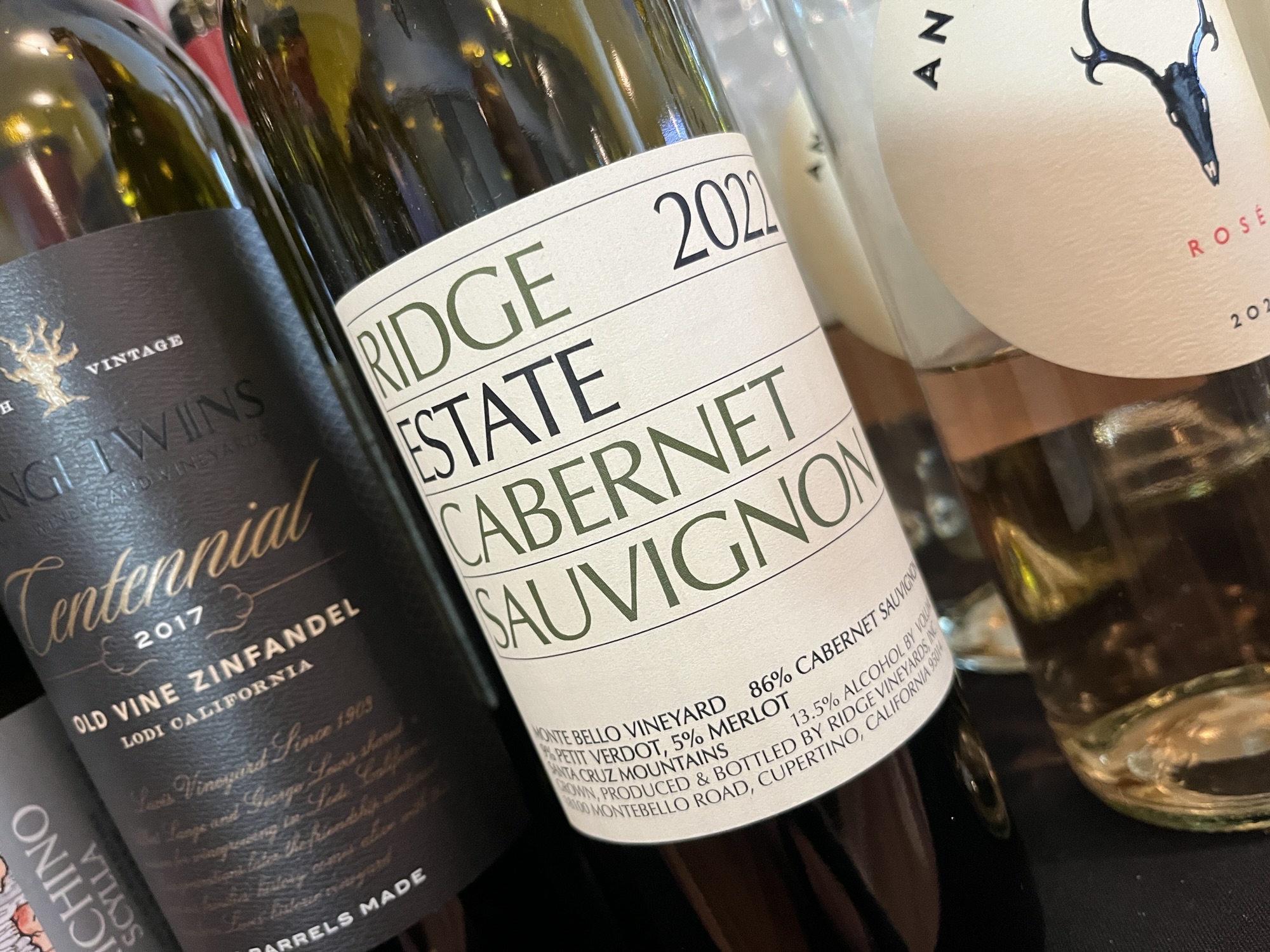
Ridge Vineyards Estate Cabernet Sauvignon 2022
52% new oak. 86% Cab with some Petit Verdot and Merlot. 12 months in oak. The best wine in this lineup. Has that chocolate lead pencil Bordeaux oak pencilly edges and the powdery tannins to match (but it’s American oak go figure). A dense and slightly uncompromising wine. Lovely brightness and a sort of powdery delicacy to this, even though it’s cloaked in molten oak. Excellent wine, that will only get better. I loved it.
Best drinking: now or in decades to come. 18.7/20, 95/100. 13.3% $US100.
A few more highlights

Both these Williams Selyem Pinot Noir 2023 wines had acres of Pinosity, with this contrast between bright red pippy raspberry fruit and a side of autumnal spice. I thought the Russian River Valley wine had the edge, but both were very enjoyable.
After the superb Ridge Cab, I wandered over to a small tasting of Ridge Vineyards things, with a Geyserville Zin (vintage unsighted) showing again that mastery of moderated texture and power of what is one of my favourite American wineries.

Finally, I really enjoyed this Freemark Abbey Sycamore Vineyard Cabernet Sauvignon 2018. Grandiose, still youthful and rich, with these grainy tannins that still hadn’t resolved, it felt every bit the top-shelf Napa Cabernet, with the many hundred dollar price tag to match.
Help keep this site paywall free – donate here

2 Comments
Thanks Andrew. I had zero to do with picking our wine to be at that Masterclass, though I am grateful for its presence, and our inclusion by Elaine. I think the mandate of the California Wine Institute was to focus on wines already imported and available in Australia, and also make a special effort to feature wines from tiny operations like our 2 person company, rather than just the usual wineries with multinational backing or billions of dollars. Just to touch on your comment on the $: we don’t have much control over that, especially folks like us who dont come from 3rd generation wine growing families or prior careers in oil or banking or tech. Land and farming here are not cheap. I am no expert on such issues, but isn’t there something like a 30% WET tax paid on the wholesale cost PLUS the import costs PLUS the insurance AND duties on all wines imported into Australia? Coupled with the exchange rate– which our Orange menace has been working on eroding globally along with everything else American– does that not dramatically jack up the pricing there? I know nothing about the Shit sandwich to which you refer, but am sorry for whatever that is, and wish governments would stop mucking about with agriculture, and penalizing the farmers and growers everywhere with these sorts of things. Careful, negotiated agreements over trade are needed, and the way to go, and clearly that’s the opposite of what’s been happening lately. Glad you liked our Scylla enough to call it a drinker- it’s meant to be exactly that, as it’s the most accessible of our reds, and US suggested retail $23 rather than $30. You might enjoy our Grenache from 115yr old organically farmed bush vines from Besson a bit more. Or our grippier, even more moody, brooding Rokurokubi & Inugami- from Mourevdre planted 1895, Grenache 1910, and Cinsault from what I believe the oldest vines left on earth planted 1886. Or maybe you wouldn’t! We don’t pick for concentration, ever, but hope to find balance and depth and flavor and (except for a very few including 2 wines of ours in Oz) generally make single site, single variety wines to allow expression of place to shine through. Cheers! Alex from Birichino, Santa Cruz
Thanks for weighing in Alex, and one day I’ll make it back over to try your full range.
I get the pitch by the wine institute to make it a representative tasting but it felt like a missed opportunity – the room was overflowing worn the best in Sydney wine trade, expecting a masterclass on the best in California (which wasn’t fully reflected in the lineup). It’s especially stark when the broader tasting had so much more greatness.
As I mentioned, there are some good points about tax – the wet rebate does shift the needle for Australian producers. Important to note that local wineries only get $350k worth on that rebate, which means it largely helps small wineries, so the only difference is the 5% duty and shipping extra for imports equivocally. The imported drawback system means that Californian wineries can also bring in wine from anywhere (hello bulk EU juice) and then claim that back too. It’s messy on both sides!
The shit sandwich is that California should be lobbying to single out Australia for increased taxation, when really we’re not the ones distorting the market. The wet rebate is only for wines sold in Australia so really it plays less of a role in the US wine market. Yes Australia is a bulk wine producer, but we’re still talking small bikkies when California alone makes circa 2600 million litres and Australia exported 100 million litres to the whole of the US.
As you say, there’s a discussion to be had, as the taxes are very messy – we’re not even getting started on the new 10% tariffs on ALL Australian products, not just pissy wine (50% tarrifs on our steel!).
Anyway, onwards and keen to try your wines in the future